Sunday, July 25, 2010

Which of These Things Just Doesn't Belong Here?

One of things I loved about having small children was watching Sesame Street. I especially loved the double meaning songs and jokes; one meaning being over small children's heads, although they were oblivious. The creators were brilliant at keeping us adult children engaged with our kids. A favorite of mine was Letter B, sung by a quartet of shaggy-haired muppets. It brings a smile to my face even now. Another song that still goes through my head frequently was the introduction to a matching game: One of These Things Just Doesn't Belong Here.

A one-time friend discouraged me from planting a banana tree at the corner of my house. She said it isn't native to North Carolina, that it doesn't belong here. As it happens I am not native to North Carolina either. I am not even native to the South. And yet, here I am. I have thought many times over the years that I don't belong here. I know I was out of place in Mississippi the four years I lived there. I don't know if I ever could have belonged there; in large part because I didn't want to. The escape from purgatory to North Carolina came none too soon.

But really, are we not all immigrants in this country? I grew up in Washington State, to parents who emmigrated from Michigan and Tennessee. REI, Starbucks, and Nordstroms followed me across the country from their original place of belonging. I like this state (though I would rather be in the mountain end) and I like banana trees. We leave one home and we make another place our home. If we believe we belong, if we want to belong, then we do.

I have strayed off the map so many times over the past years that I sometimes haven't known if I even belonged in my own life: I began in the Pacific Northwest and have ended up in the Southeast. I thought my life was meant to be encased within another’s, like Russian nesting dolls. I unquestioningly followed the plan to be married to and supported by a husband until death do us part, and I ended up divorced and the sole support of myself. I never questioned my heterosexuality, but discovered myself as a lesbian after nearly 20 years of marriage. When I was 40 I went to graduate school, expecting to be a counselor, and ended up a bookkeeper. Have I lost myself? Or have I found myself? Did I not belong then, or do I not belong now? I have stopped asking the questions. I believe I have always been myself; I believe I have always belonged. I have always belonged in the moment. We are at least partially responsible for what comes next, but we can't predict it. I can't predict forever success in the garden, but I am willing to give anything I like a chance. I will enjoy the plant until its time is up, whether it's a month or a decade. I have never lived a lie. I have never failed at anything, which doesn't mean it lasted forever. I am not sorry for any of my choices, or any direction my path wound. I have no regrets. All any of us have for sure is right now.

I am sure you have been asked, perhaps by a therapist or the author of a self-help book, "Where do you want to be five years from now?" It's a favorite question of those who think they know how to help us get motivated. I have tried to answer the question, perhaps it's why I went to graduate school. The truth as I know it now, though, is in five years I want to look back and know that I lived those years, that I took risks, that I wasn't afraid--or if I was, I did it scared. Five years from now will take care of itself. These moments are the ones that matter; I will never get them back. I am not, anymore, easily discouraged from trying what I want to try: being a counselor, living alone, camping by myself, playing the violin, subscribing to Match, planting a banana tree.

I gave birth to my own children, but I am a strong believer in the beauty of adoption. I read articles and receive advice about planting native plants and drought resistant plants in the garden. In one column the author/gardener said he plants his garden and never waters all summer. That sounds plain dull to me, though it would provide more time to sit in the air conditioning and watch TV, instead of sweating outside. My garden is my family now; I take care of its needs, it depends on me, and it gives me pleasure. There is a lot of adopting and adapting going on in the garden.

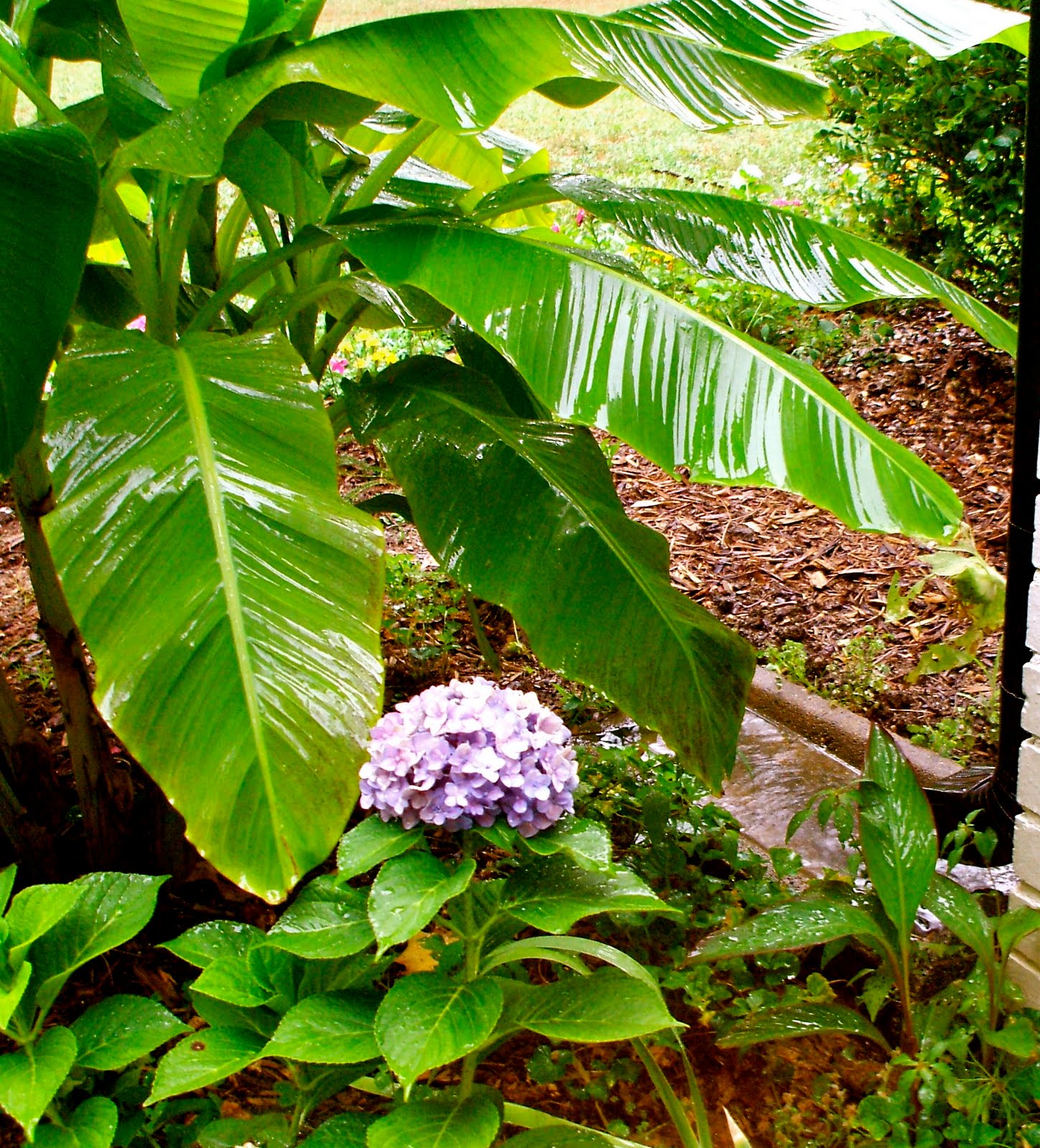
Last fall, just before the last chance planting date, I planted my banana tree. I followed the advice I read and after first frost I cut it down to the ground and mulched it. (The other option was to cut it a few feet above the ground, build a heavy gauge chicken wire coop around it and fill it with mulched leaves. That sounded a bit too much like taking care of children.) In the spring I eagerly watched for emergence. Nine stalks sprouted in an area the size of a dinner plate. I didn't know if I should thin the grove or not, so I let it make its own way. "One of these kids is doing her own thing." Now it is healthy, lush, and beautiful; but not tall, at least not yet. I asked a sister gardener I met while walking in my neighborhood about her banana tree. She told me to cut it off as high as I can reach and leave it. No need to mulch in this climate, especially if it's near the house. In the spring it will sprout out of the dead stalk and have a head start on height. I love things that sprout from dead stalks. Hydrangeas do that, too. So do I after the winter hybernation.

After the risk of frost last spring, I planted a variety of seeds in my garden. When they sprouted, I found that I couldn't tell the seedlings from the weedlings. I didn't know what to do. Should I pull the ones I think are weeds? If I guess, I risk pulling up the desirable plant. I chose to watch and wait until it became clear. Just as I waited to discern the difference between flowers and weeds in the garden, I wait to see which vines of my life now will hold my heart together and which ones will squeeze the life out. It is not always clear at first. Which vine is the passion flower and which is the cat briar?

Believably, 2010 is the hottest summer on record here; yet I am enjoying being outside more than I ever have. Not working, just sitting, away from pavement and cars, in the shade of the dogwood tree that catches the breeze. Watching and listening to the birds that flock to the feeder and flit and zip through the trees. I got a backyard birds book and I am learning their names. Yesterday the fluffy young cardinals discovered the feeder and entertained me for an hour. The titmouse and chickadees, so cute, have started stopping by. I keep an eye on my plants and discern which to plant more of next year and which ones don’t want to belong (they are my Mississippi plants). Sitting in the dark under the tiki lights I listen to the cicadas and watch the dance of fireflies. I have let go of the fact that it is ridiculously hot. I have stopped complaining about that which I can't control. I have decided to belong to this moment in this place.

And I planted a banana tree. It reminds me of a magnificent day of hiking through small banana farms in the hills near Mt. Kilamanjaro three years ago when my sister and I visited my Peace Corps volunteer daughter in Tanzania. Everytime I brush by my tree(s) and look deep into its broad leafed soul I am transported back to that day. Back to that day in a country in which I didn't belong. And yet, there I was.

Sunday, July 18, 2010

Thirst

It rained this weekend--lovely, thirst quenching, rain barrel filling, dancing, singing, blessed rain. I think it's been a month since significant rain fell on my garden. On Friday night I stood on my deck, turned my face to the sky and let it wash away the dusty draggy feeling of drought. The rain washed over me as it filled the pores of the garden. Renewal.

I get tired of the summer garden, watering and weeding. The plants look tired, too. I water, and it keeps the plants alive, but it can never be the same as Mother Nature's rain. This summer I am being intentional about loving the garden through the dry periods, the time span when there seems to be no growth (except for the crabgrass and ground ivy; though if not for those and other exotic "grasses" I would have no lawn). Does God as gardener get tired of me during my frequent droughts? Or does the Gardener wait it out with me, pay closer attention to me, patiently helping me see beauty in my life when it seems there is none? And so I am looking hard for the less transparent beauty in the garden. I am staying outside in the heat so I can see. Here is what caught my eye this week:
     1 The sparrows at the cafe where I write were back with their young. They perched on the edge of my table, they bounced around looking for food, the mama checked out a couple of things and rejected them (I think it was sugar granules from my scone--perhaps she knew it was not nutritiously worthy of feeding to her offspring). She fed the youngsters in turn, even though one wanted more than its share. A young one chirped indignantly when the family flew off without it before it wanted to go.
     2 There was a bright green dragon fly on the Carolina jasmine on my porch rail, and a baby praying mantis on the summer phlox.
     3 I harvested my first two sunflowers. I have been watching for the seeds to turn the characteristic black striped that we know of sunflowers seeds in the cellophane bag at the market. I cut the two down and hung them upside down in a paper bag in my shed until the seeds finish drying and fall out. They will provide food for the birds this winter.
     4 In times of drought, the plants put all their energy into preserving their core. Many of them don't flower, they don't grow, some wilt (as much from heat as from lack of water--like me). After the rain the blooms on the plants pop back within hours: the pentas, the Mexican heather that hasn't bloomed for many weeks, the impatiens. I swear the clumps of vinca and marigolds in my front garden doubled in size between Saturday morning (before the rain) and Sunday morning. All that was wilted is standing straight. Some have burned leaves from the heat and drought; they will take longer to fully recover, but they will. They will recover in spite of the parts that are lost.
     5 The Sum and Substance giant hosta and the Purple Heart have funnel shaped leaves; it's as if they were designed to catch the rain and direct it to the roots.

In times of drought the plants put their energy into preserving their core. Don't we do that in our lives, too? When we are grieving or facing serious illness or transitioning, we shed all that is not essential to survival and concentrate on preserving that which is central. Sometimes all we can do during a dry spell is wait it out. One of the essentials for me during the time of waiting is tears. A bit of wisdom I learned in counseling school is that, while therapists (and friends) should keep tissues handy, we shouldn't shove them at a person at the first tear sighting. We need our tears. We need to learn to be okay with them; to welcome them as a friend. Tears let out the frustration and disappointment. Tears keep us watered and at the same time keep us from drowning in held in grief. (How ironic that a few minutes after writing these words, Leslie Gore is singing, "I'll cry if I want to" on the cafe musak.) Words on paper also take sadness out of my soul and into the world where I can look at it. And friends are essential to me. Friends who know when to push and when to hold on to me; friends who know when to let me be and when to get me into the world. Friends are central to my self-preservation.

I have noticed over the years that sometimes what I receive from friends and my writing and my prayers is not what I want to hear. Often it makes me angry and resentful to receive what I need. I don’t know if that is what happens when the plants first get the desperately needed rain and they droop from the unaccustomed weight of it, but it is what I thought of when I saw them lying prostrate on the ground during yesterday's rain. But in the end, when we are ready to let it soak in, the truth brings us back upright to the fullness of life.

Yesterday thunder rolled through the sound waves for hours. The sky turned dark with expectation of more needed, hoped for rain. And then the clouds moved on. The thunder kept rumbling in the distance, the sky turned dark again and then light again. This has happened several times over the past month, with no rain. Expectation. Disappointment. A relentless cycle. And then the rains come. So often we feel on the verge of something wonderful in our lives. We prepare for it, put all the ducks in a row to make it happen. We are ready. And then something shifts and it doesn't come. Expectation. Disappointment. 

I am rereading, for the unknownth time, one of my favorite books: Everyday Sacred by Sue Bender. I always seem to know intuitively when I need to read it again, and my eyes notice it on the shelf. The author tells the story of three bowls. "The first bowl is inverted, upside down, so that nothing can go into it. Anything poured into the bowl spills off. The second bowl is right-side up, but stained and cracked and filled with debris. Anything put into this bowl gets polluted by the residue or leaks out through the cracks. The third bowl is clean. Without cracks or holes, this bowl represents a state of mind ready to receive and hold whatever is poured into it."

The bowls remind me of the Sum and Substance hosta and the Purple Heart with their funnel leaves; holding the water until it is ready to trickle down to the core of its being. Sometimes I am that first bowl, so busy being productive or otherwise ignoring whatever it is that I don't want to look at, that I don’t notice when the very thing I want presents itself. Sometimes I am the second bowl, with such a fierce judging voice that focuses on what is not working or what is missing or the disappointments, that I am unable to see or appreciate all the things in my life that I love. And sometimes, wonderful times, I am the third bowl, able to be present and absorbed in what I am doing, whatever it is.

Most of the plants in my garden don't die from thirst, just like we don’t die from disappointments. We look to our core strength to help us hang on until we can ask ourselves again, “What do I thirst for? What do I need in my bowl? What do I want in my bowl?” And even, "What wondrous things are already in my bowl?"

Sunday, July 11, 2010

Dividing the Garden

I joined the NAACP last week. And I let my membership in AARP lapse. I feel more need to show solidarity right now with people of color and those divided by socio economics than I do with retired persons. I am outraged by the actions of the majority on the Wake County school board. I will leave to others who know more than I about what a return to neighborhood schools would mean for diversity in our community and beyond, but the behavior and rhetoric of the school board majority and the hatred and inhumanity of their followers that write letters to the editor and online responses to news stories, simply put horrifies me.

Division has a place in the garden. Recently, on one of those "cool" days in the 80s we had a couple of weeks ago (it seems a distant memory), I edged my sidewalk, dividing my lawn (or the weeds that I call a lawn) from the pavement. I re-edged my garden to keep the lawn from encroaching. One of my beds has the less-than-attractive black edging around it, while a brick border separates other beds from invasion. All to keep lawn and flowers separate, but equal; all in their place. Bulbs need to be divided so that they can grow better. Trees and shrubs need to be pruned in order to thrive. Weeds have to be pulled because they will take over if given a chance. I have boxed flowers into containers rather than let them roam free. But this week I have been thinking about the way we divide people from people.

Five of the books I have read this summer, by pure coincidence, have similar themes: The Help, Katherine Stockett and Blood Done Sign My Name, Tim Tyson (the southeast in the 1960s); Stones into Schools, Greg Mortenson (the middle east in the present day); The Postmistress, Sarah Blake (Europe and the USA, WWII); and The Things that Keep Us Here, Carla Buckley (current day pandemic). Each of them are stories of divisiveness; of one side against another; of the consequences of holding one group of people down and using their backs for one's own climb to the top. Us and them. This is the strong root giving life to family squabbles, neighborhood rumbles, city riots, and international wars. I see that happening in the neighborhood school takeover: people in power using their status to do harm in the name of doing good--for their own kind.

We self-divide all the time. We choose what church we will attend and what neighborhood we will live in. We rule out friendship with certain populations of people, sometimes by choice and sometimes by lack of opportunity; sometimes by inability to communicate due to different languages, interests, or experiences. We make decisions, consciously or not, that separate us from those who choose differently. Although these are our choices, I daresay we are always the lesser for it. But why do we choose these containers? I believe it's often because we are afraid of what we don't know, it makes us uncomfortable. And we don't know it because we didn't learn it. And we didn't learn it when we were children. We hang on tight to what we learned in kindergarten, for better or worse.

I grew up in a small town that was divided only by railroad tracks: socio-economic division. There were no people of color in the entire population of the town, much less children of color in the classrooms. There were four elementary schools and we went to the one nearest our home, but we all joined together at the solitary junior and senior high schools. One of the neighborhood schools was in the center of town and the other three on the edges, beyond the tracks. The town school was exclusively the relatively upper class students, one of the others was the lowest income level, and the other two were mixed low and middle income. When we all arrived at secondary school, I longed to be in the Edison School clique, a clique that remained securely intact for the next six years. The Logan School kids remained, for the most part, the untouchables. PE teachers sometimes chose those kids to be team leaders because they were the toughest; and even they, in the unconscionable custom of letting the captains chose teams child by child, picked the Edison girls first. I am grateful beyond measure now, that I was not fenced into a clique, that I was not among the chosen few. I can see now that adult cliques are what happens when we don't learn early in life that the world is not made up of people just like us, and that none of us are better than anyone else. If we don't learn to play together in the sandbox or share stories in creative writing class, we will rarely be able to do so as adults. And those who are oppressed will have nothing to lose by fighting with violence and hatred for that of which they have been deprived. And in one way or another, most of us have some level of oppression, even if only because we have been kept in containers in elementary school.

One of the arguments for neighborhood schools being touted by the school board majority is that kids shouldn't have to ride the bus when there is a closer school. I am pretty sure they never asked the kids if that is a hardship! My first two years of school the bus passed my house twice. Every chance I got I caught it on the first passing so I could ride to the end of the route where my best friend, Maggie Jo Cummings lived. The next four years, in another town, I could walk or be driven half a mile and catch the bus on its last stop or I could get on at the end of my driveway, the first stop, and ride for an hour. (Of course, it was reversed on the return trip.) I usually chose the long trip (if I could get down my Cocoa Krispies--the only cold cereal I would eat--fast enough). I liked the view around the hill and through the dale, I loved watching the day break, I needed the transition time between home and school and back again; I did my homework; and I saw how others lived and spoke to those I would otherwise not have known.

I tried to enlarge a strip of garden in the midst of this drought. Now if I had actual grass, it might have come up easily; but weeds hang on with impressive tenacity, especially when they don't have enough water. I finally had to give up the fight. It is only through the water of education, a spirit of open-mindedness, an acceptance that we are all children of the one who is More, a willingness to sit side-by-side with people with different experiences than our own, even when it makes us uncomfortable, that we will let go of the dry soil and learn to live and work together in the world rather than dividing and destroying ourselves and each other.

Division and containment have their place in the flower and vegetable garden, but not in God's garden. Children who go to school with their own kind, are more likely to feel a sense of entitlement to preserve that lifestyle as adults. Sometimes we have to box teenagers and adults in because they are believed to be in danger of harming themselves or others. They were boxed out as children, and consequently later they have to be boxed in. No one, no one at all, is well-served by a world of people trying to preserve the garden for themselves.

Sunday, July 4, 2010

Hang on Little Tomato

I touched the first red grape tomato, intending to give it a gentle squeeze to see if it was ripe, but it let go of its tenuous hold on the vine and fell into my hand. Nothing to do but pop it in my mouth, bite down and burst the slightly tart juice over my taste buds. Perhaps not quite ripe, but it was my first homegrown little tomato.

When my sister gardener and writer (I'll call her Mel) gave me a tiny snap pea plant from her garden, I had had no thought of expanding my garden into the edible arena. But in the spirit of accepting a gift, I weeded and dug up a sunny, unplanted strip of earth along the chain link fence, enriched the soil with Black Kow and the first single bucket-full of rotting vegetables I could harvest from my small compost area, and stuck the plant in. (I laughed to see the not-quite-decomposed Brussels sprouts leaf and asparagus stem adornment.) It gave me a brand new spark; I went to the Farmers' Market and got a 4-pack of grape tomatoes and planted them, too. Then I sat back to watch for the results of my first foray into vegetable gardening.

Sadly, I only got two peas off the pea plant before something ate it. However, in addition to the grape tomatoes, a roma and three vine-ripened tomato plants and two squash plants are thriving. Where did they come from? I puzzled for weeks, before finally being clued in to the likelihood that they came from my bucketful of compost. A couple of weeks ago I counted more than 150 tiny green tomatoes. (There's not a lot to do in the garden right now.)

When Mel gave me that tiny plant, neither of us had any idea what it would start. A simple kindness that extended well beyond the edges of the gift. Next year I will widen the strip and plant the whole thing with vegetables. The point is, we never know when a word spoken to a friend or a smile directed to a stranger or an act of kindness shown to someone who may or may not have deserved it could touch a heart for a lifetime. (I should say here that everyone deserves kindness, it just may not be evident.) And how will those acts, given or received, change a day or even a life? “What happens to a story around the edges?...A story like a snapshot is caught, held for a moment, then delivered. But the people in them go on and on. And what happens next? What happens?” (The Postmistress, Sarah Blake). We most likely will never know that we have made a difference to someone. We won't know what happened next. All we have is the moment.

When I was eight, my family moved; but before we left Olympia behind, my big sister and I commuted with our dad for a few weeks so we could start in our new schools at the beginning of the year. That first day of third grade, Daddy and I walked into the school office. Daddy told the man at the counter (who happened to be the principal) my name and that I was a new student. A woman with her back to us turned around with a big smile and said, "Oh! She's mine!" She took my hand and walked me to the classroom. Those three words changed the course of that day, and all the days to come, for a frightened little girl. Thirty years later I ran across a birthday card she had sent me some years after I was her student. I set the card aside to remind me to write her a letter to make sure she still knew how much that day and that year in her classroom meant to me. Three weeks later, still not having gotten to that note, the mail held a letter from my mother containing Mrs. Rucker's obituary. I know I had told her that she changed the course for me (she served tea at my wedding, after all); I hope she still knew.

It should be remembered that bad deeds and angry words can also change the course of a life. My second grade teacher's name was Mrs. Louderback, and she was the troll under the bridge who ate billy goats and second graders for breakfast. And that's all I'm going to say about that. We all have words or actions we wish we could take back. Even if they aren't remembered by the receiver, they may be still hurting the one who delivered them. You know what I mean.

Today is Independence Day. I am not always proud of how my country, collectively or individually, treats others. Horrendous actions have been taken in the name of the stars and stripes. But, nevertheless, I am always glad that an accident of birth made this my home. And I am grateful to the courageous men and women who came before me. Some, like John Hancock with his bold and pompous signature on the Declaration of Independence, proclaim a self-knowledge that they are changing the course of human events, and they are well-known. But most are nameless people who unbenownst to them changed one life with a kind word or deed. Those actions increased exponentially to change a family, a neighborhood, a region, a state, a country, even a world.

Tiger lilies are a fascinating study in the unexpected. Their long, narrow, bright orange bud is unusual  in and of itself; but who could imagine what is hiding inside until it opens up to a most amazing flower. Five years ago my pastor sent me on a pastoral visit to a church member whose marriage had just ended. My second relationship had recently ended; I guess she thought I could provide understanding and comfort in a traumatic time. I listened, I let her cry, I was a caring body in the other chair. As my friend Jack says, much of ministry is just showing up. And we are all ministers. That difficult day changed the course of at least two lives. She tells me often how much it meant to her; and I her, as it was as much a gift to me. That single hour opened up to a beautiful and enduring friendship. I was asked to show up--and the affirmation in that simple request started the ball rolling. I said "yes." The door was opened to me and I was allowed into a life. And it changed the course.

We never know what a gift or a kindness is going to start--or how long it will be remembered--or how many lives it will touch. If we all lived life with the knowledge of the potential in each encounter, at the very least our own lives would be better for it. And perhaps that is all there needs be to justify our space on the planet.

Sunday, June 27, 2010

Clouds from Both Sides

The song has been stuck in my head all week. Normally that would make me a candidate for a padded room, but I decided to pay attention. I googled the words (though I could have looked at the back of my 1970s Judy Collins' album jacket).

     "Bows and flows of angel hair and ice cream castles in the air
     And feather canyons everywhere, I've looked at clouds that way.
     But now they only block the sun, they rain and snow on everyone.
     So many things I would have done, but clouds got in my way."

Have you ever flown past the ice cream castle and feather canyon clouds on a plane? I count it among the most incredible things that one can experience. On occasion, the plane cuts right through them. They have no substance. And sometimes the plane passes through storm clouds on take off, and continues on its journey above them. On a long journey the travelers might fly beyond the clouds, but often we have to come back through them to the rainy side to land. And though there is some buffeting about coming through storm-filled clouds, and the lightening flashes, and nervous flyers like myself wonder if the plane will land safely, it rolls onto the runway with a sigh of relief and we all go about our lives without a backward look. Even storm clouds have no substance other than our own fear and resistance.

I have let the words to the song roll around in my head. Clouds, both angel hair and black stormy ones, are part of a balanced life. Joy and loss come together, they are both sides of the same cloud. I can see that expecting my journey to be one way could have gotten in the way of living into the path of reality; idealizing a relationship or a job or good health into a sense of entitlement. And when our expectation of the way things should be doesn't continue to happily-ever-after it can jade us into thinking that there is a dark cloud permanently blocking our personal sun. We have a choice, stay in the stormy place--or the idealized place--or come through to check out both sides.

There is no room for expectation in the garden, either. Gardening is a humbling exercise in letting go, so much is out of my control. If I expect it to behave in a certain way, it will let me down. Sometimes what I plant grows, and sometimes it doesn't, and sometimes it gets eaten by insects, slugs, rabbits, or disease. Some perennials come up for two years and the third year they don't or they are puny. (The other side of that cloud is that sometimes volunteer flowers and even vegetables come up where I didn't plant them.) A friend gave me a tiny chocolate vine sprout--apparently its flowers smell like chocolate. Something was eating it, so I dug it up and put in a pot on my deck in the relentless heat and forgot to keep it watered. She says it could come back. There's room for hope, but not expectation.

Sometimes my life feels out-of-sync. This week I have felt particularly off balance. But nature is not always in rhythm either, or it doesn't seem so. The garden has had too much heat and too little rain this month; sometimes it needs its human gardeners to thrive. And one night I watched the female fireflies flashing in the grass, but there were no males in the trees looking for them. The next evening the males were there, but not the females. I knew a little about fireflies--enough to know that what we observe is not all peace and beauty--but I went on a Google exploration to see what else I could discover. There are more than 2000 species of fireflies and there are indeed some subversive and brutally aggressive ones. (Not unlike some varieties of humans.) Fireflies live underground in a larval state for two years and live above ground for two weeks before they die. Their lives are all about reproducing and providing a bit of beauty for human enjoyment. It seems a sin not to sit outside in the heat and mosquitoes and appreciate them. (If you want to know more about fireflies and their light patterns google "Blink Two Times if You Like Me.")

I discovered stars this week. I have become so accustomed to not being able to see them in the city that I don't look for them. I lay on my back in the grass after twilight, surrounded by the solar lights I recently put around the perimeter of my yard. The stars are weak, but they are there. I was an audience of one for the evening performance--the dramatic and beautiful dance of the fireflies weaving their lights high in the trees looking for love, accompanied by the song of the cicadas. I created a magic mood with my solar lights, but they were only the set design to Mother Nature's opera. (I am sure I don't need to point out what I would have missed had I observed my lights from inside the glass door.)

     "But something's lost but something's gained in living every day."

True joy must be willing to embrace impermanence. I am learning to grieve the losses in my life, again and again; and to embrace the joy of the present. Loss and joy, different sides of the same cloud. Life's illusion is that we think we have it figured out, that we are in control. But we are not. When we let go of expectation, then we can truly be alive.

     "I've looked at life from both sides now,
     From win and lose and still somehow
     It's life's illusions I recall,
     I really don't know life at all."

And now I hope I can put this song to rest.

Sunday, June 20, 2010

Marking the Years

I don't know about other civilizations, but this one has an obsession with anniversaries. Young lovers celebrate their time together in months, or even weeks; partnered couples mark the years; and, happily or reluctantly, we all make a nod to our annual birth anniversary. We also remember less happy occasions each year: divorces and deaths. In my nuclear family and family of origin, June is heavy with anniversaries. I mark 58 years today (Father's Day). I share my birth month with my mother, one sister,  and my son. It is also the month my son and daughter-in-law were married. And 15 years ago tomorrow, on the longest day of the year, my father died.

I was out for a walk that evening at twilight. Nearly home, I rounded a curve on the greenway into a small glade. Before me were more fireflies than I had ever seen; their hundreds of little lights flashing in the grasses and just above the ground. I stood mesmerized for several moments before walking silently through them. It is the closest to magic I have ever been. Thirty minutes later my mother called to tell me my father had unexpectedly died...thirty minutes earlier. I have been back to that glade at the same time on the same day. I have been to mountain glades that are known as firefly mating areas. I have never seen it again.

June is also an abundant anniversary celebration in my garden. The annuals I planted from seeds after the last frost began to bloom this month. The first sunflower opened its face yesterday. The hostas, summer phlox, and Rose of Sharon began their blooming this week. The tiger lily buds are pregnant with expectation. The plants and flowers are all my favorites in their own unique ways. I feel the same way about my friends who joined me last night to celebrate my birthday, that of my friend, Grace, and the summer solstice. As I looked around the circle under the dogwood tree, in the flickering flames of the tiki lights, I felt incredibly blessed. There were new friends, friends I have known for several years, and friendships renewed. I saw in my heart,  the friends who couldn't be there. Each soul is unique, and together they make a whole. A whole heart, a whole community, a whole family. I need them all in my life.

As I grow older I find that I am less and less inclined to believe one person can fill all the nooks and crannies in my life that need filling. But when I have been in a primary relationship I have lost that knowledge, and my Self with it. Perhaps that is why I don't seem be able to be monogamous. Not in the biblical sense, but in the wholeness-of-life sense. For the first time in my life, I don't feel that any one person has Most Important status. Also for the first time in my life, I have a community that is Most Important. And I am grateful. 

The garden would be a dull place if the same flower filled each space. The Raleigh Rose Garden is a beautiful sanctuary; but though there are many unique varieties of roses, they are still all roses. I want some in my garden, and I have a plan to add them; but have you ever gently wrapped your fingers around the incredible softness of a ball of hydrangea petals? Breathed gardenia-infused air? Contemplated the face of a sunflower reaching for its mother sun? Delighted in the fireworks imitation of allium? Found the first spring bloom of crocus? Watched a banana tree grow before your eyes? And the balloon flower: my prize for most fascinating transformation of bud to bloom; the name says it all. It puffs up like a balloon, changing color from green to periwinkle, then bursts open. Its unfolding reminds me, too, of the paper fortune tellers we made as children.

As each flower and each friend provide me with something only they can, each flower and each friend ask something different of me. They require me to stretch, to look for what I can uniquely provide, and to look for opportunities to extend that love to them. As I mark this birthday, my intention for the  coming year is to find new ways to show extravagant love to the dear ones in my life. And to allow them to love me back in their unique and wonderful ways.

To Ed, the father of my children; to Nicholas, the father of my grandson; and to George Russell Staebler, my imperfect and beloved father--I wish you peace, love, and flowers.

Sunday, June 13, 2010

If You Can't Live in the Place You Love, Love the Place You Live

I always thought the song of a similar title was inane. Why not keep looking for a way to be with the one you love? Why settle? My grandmother once told me she was in love with a young man in her youth, but she ended up marrying his widowed brother who was 20 years her senior and had six children who needed someone to take care of them. She told me she guessed she learned to love him. Maybe I don't get the song, but I always think of my grandmother when I hear it.

Thirty-four years ago this summer, my new husband and I packed a smallish u-haul trailer with all our belongings and moved across the continent from the Pacific Northwest to the Southeast for what I expected would be two years. We don't always get what we expect. The husband has been gone from my life for 16 years and our two children, born in Virginia and Mississippi, are grown; and here I remain in North Carolina, the place we lived when we became a family apart. I have not used an inherited map on my life's journey, although I expected to. We don't always get what we expect.

I still miss Washington, and I have been free to return for several years. My daughter even lives there now. Why don't I go? Maybe because I am happy here. I have a job I enjoy, a home and garden of which I am enamored, and friends I love and who love me. But every once in a while I get a niggling feeling that there might be more to this life than I am being shown. What is it? Where is it? Is there something more I am meant to do or see or be? How do I find it? Barbara Brown Taylor (An Altar in the World) says, “The last place most people look [for the missing treasure] is right under their feet, in the everyday activities, accidents, and encounters of their lives… We cannot see the red X that marks the spot because we are standing on it... All we lack is the willingness to imagine that we already have everything we need. The only thing missing is our consent to be where we are.” Maybe that is what the song is about.

The sunflowers I planted in my garden from seeds are way over my head now. They have not bloomed yet, but the buds are growing larger. Even in their immature state, they turn their faces to the sun. When I check on them before leaving for work they are turned to the east. When I return in the evening they are looking west. Their heads don't droop as they wait for the sun to come back their way; they follow it wherever it goes.

My grandmother made the best of what life handed her, I guess. But she did not follow the map her life and times, and her husband, laid out for her. My grandfather did not want more children, but she did and she had four; the second one was my mother. I have often wondered how he expected to keep from getting her pregnant, and how she defied him. Yes, I know how babies are made, but in that day and time I can only think of one way they might have avoided it. I guess she was really fertile. She rented rooms in their home and managed the boarding house to bring in money. Later, after she raised the ten children, she left her abusive husband and moved across the country to live near my parents...not the map she was "supposed" to follow. I am so enormously proud to be her granddaughter.

For the past couple of years I have set an intention to notice what is happening around me every single day. I figure I may not recall the details years from now, but hopefully I will remember that I was awake at the time, and that will be enough. Some days I even think to follow through on that intention. But I don't know that I have very often consciously decided to love the place I'm in; to look for and make an accounting of what I love about it.

Growing up, my family visited my mother's home in Tennessee. Yesterday as I sat in my garden in the close, humid, gardenia-infused air, I closed my eyes and went back to those days. More than seeing, I feel myself sitting on the porch swing on the wrap-around porch of my Aunt Fannie's house in Maryville (pronounced Mer'vulle), Tennessee. The evening air has an exotic, unfamiliar heaviness. Fireflies light up the lawn at dusk and we catch them in canning jars with holes punched in the lid. I imagine going to bed on a sleeping porch my mother has described to me--designed to take advantage of whatever movement might be in the air. Thunder booms and lightening pierces the sky. Then the rain comes and pounds on the tin roof. There are no fireflies in western Washington; there is almost never a thunderstorm; and the rain doesn't ever blow in suddenly and pound down for ten minutes to be replaced immediately by sunny skies.

The incredible damp, evergreen smell that drifts through the air in the Pacific Northwest, however, is home to me. The hills and the snow-capped mountains and the driftwood strewn beaches are home. It will always be so because when we talk of home, we are really talking about our childhood home--for better or worse. I love it there; I probably appreciate it more now than I did then. All those years ago I loved visiting the Southeast. And then we returned to our taken-for-granted home. Now I love visiting the Pacific Northwest and I come home to my familiar home in the Southeast. Because home is right here under my feet: my family of friends, the fireflies, the thunderstorms, the humidity.

And so I am not staying inside this summer. I live in the South, it's hot and it's humid. Life is messy and sometimes we sweat. I sit in the shade of the dogwood tree with a book and a tall glass of ice water garnished with mint grown in my garden and a slice of lemon. I still don't like iced tea, but maybe this is the summer I will learn to make mint juleps. I breathe in the unique scent of the south that hangs in the thick air and watch the birds swoop from tree to tree and listen to them call to each other. I watch the sky for gathering storm clouds. If I had a covered porch, I would sit outside and watch the storm. Last night, from my bed under the eaves, I listened to an approaching storm. The single long roll of thunder was a perfect expression of what I am feeling this week. It began in the distance, and approached in a steady crescendo until it sounded as if it were just above my head, then moved off in a decrescendo until it faded away. And then the rain came and watered the garden. I breathed deeply and returned, satisfied, to sleep.


Excuse me for anthropomorphizing, but I am sure the three church windows I planted never expected to be an altar in my garden. Each evening the setting sun sends a ray streaming through the tall trees onto the windows. It lingers first on one, then the next, and the next; and they glow, as they did when they graced the south wall of the church. Altars are not only in sanctuaries. Sanctuaries are not only in churches. I feel the glow of the one who is More each time I observe the sun ray; and I feel--incredibly--full. We don't always get what we expect. But we can choose to love what we get. Maybe there is something else for me, and an as yet undrawn map will reveal the road in its time; but right now the treasure is right under my feet; and it is everything I need.