Sunday, August 29, 2010

In Perpetuity

I don't know how long forever is, but I know it is longer than my lifetime, or my children's lifetimes, or their children's lifetimes. Forever is how long descendants of Staeblers and Goodells will be able to visit the Michigan farm that has been in my family for 98 years and counting.

Last week I left my not-so-big house and my not-so-big garden and my singular life with my cat, and went to a gathering on the many-acred ancestral home with some 140 people who share my bloodline or are related by love to those who do. The occasion was the celebration of my father's brother's 100th birthday. In attendance with Uncle Donald were my 94-year-old mother and my 92-year-old aunt--the three remaining children and their spouses of my grandparents, Ella Louisa Lucretia Goodell and Albert John Staebler. Joining me were my two sisters and all seven of our first cousins; along with a multitude of spouses, children, and grandchildren and various and sundry leaves on other branches of the family tree. 100 years separated the oldest and youngest in attendance. If I ever felt--and I have--that my family consisted only of the thirteen descendants and partners of my parents, I have been blessed with the realization that I belong to a much larger clan. Forever. In perpetuity.


My Uncle Donald gave the clan a gift without price. It was given a dozen years ago, but it is a forever gift. Rather than lose the place on the mid-west map where all of the family have spent precious time over the decades and about which we have heard hundreds of stories, he assured its perpetuity by selling the farm--its land and buildings and the stuff of their lives (he is a lifelong packrat)--to Washtenaw County at a less-than-premium price. The other farms that dotted Plymouth Road during my childhood, have been sold to developers who raped the corn and hay fields, razed the buildings that supported the farms and large families of the past, subdivided the acres, and replaced it all with out-of-place brick mansions with huge lawns to house the small families of the 21st century. But the Crick-'n-the-Back Farm will remain as an historical site and a demonstration farm, with community gardens and a museum of the clever implements that were used in the last century to support family and livelihood. The restored big red barn, the silo, the pig and horse barns, the milk house, the tractor shed, and hopefully the farm house will all remain for future generations of our family, and be shared with all who come. In perpetuity.

The farm and its original family of eight represent a microcosm of American cultural history from the turn of the century. The first children were born at home, the later ones in the hospital. They ran a self-sustaining farm--the boys working outside, and the girls in the house, because that's how it was then. All six children graduated from college, an amazing accomplishment. They experienced the second world war as soldiers, an overseas nurse, supporters of the war effort at home...and a pacifist--perhaps a family emotionally divided by political differences, though that is a story I do not know because they are also a family that doesn't talk about what they consider hard or unpleasant stuff. The extended family not overseas during the war lived, at least for a time, together on the farm; keeping it running by day and huddling around the radio for war news by night. My aunt Helen experienced the death of a spouse at an early age, followed by discrimination when she was turned down for nursing school by the major Michigan universities because she had been married. They held onto the farm through the great depression, eventually having to reinvent the farm from dairy to beef cattle in order to keep it alive. The farm still supported cattle and crops when an interstate was cut through the back fields of land farmed by my still-living uncle and his family before the advent of the automobile. They saw the post-war migration of grown children to points around the country and moved with the fast-moving times into the age of electricity, the space age, and the technology age. Though Ella and Albert and the five of six children who married all celebrated 50th wedding anniversaries, descendants have married for life--the first about to reach the 50-year mark; divorced and remarried, or not; been open, or not, about being gay; had children, or not, some raising them alone and some blending families; and eschewed racial barriers in marriage and adoption.

Though the Staebler name through the direct descendants of Ella and Albert, at least via the culturally established path of the male line, will die with my first born cousin, the family--and the family farm--will remain. ...

... In perpetuity. And I remain proud to be Gretchen Helen Staebler, a member of an amazing family.

Value of prime location land between Ann Arbor and Detroit? Millions. Value of an ancestral home and a vanished way of life preserved for all time? Priceless. Thank you, Uncle Donald, for your determination, foresight, creativity, and love of family. Your life and that of your parents and your siblings--Lloyd, Helen, George, Ruth, and Melvyn--will remain in the hearts of your family forever.

Sunday, August 15, 2010

Out on a Limb

As I sat under the spreading branches of my dogwood tree one humid evening last week with a glass of Cabernet, a book, and the can of mosquito repellent, the enormous cracking sound of a falling tree or a breaking limb split the thick air. Not knowing where it was coming from, I instinctively leaped from my chair and sprinted for the deck--taking my wine glass with me (I have my priorities). Just as I arrived at what I prayed was safety, I turned to see a large branch from the top of a tree next door and two branches it took out on its descent explode onto the roof of the neighbor’s garage, breaking several window panes in the door. And so, I have been thinking this week about going out on a limb and risk-taking.

I believe that nothing good ever happened that didn’t start with a risk: falling in love, marriage, babies, buying a house, moving, new jobs. They are all risks--but they aren't necessarily going out on a limb. Until I reached early mid-life, I stayed on the thick and sturdy branches nearest the trunk of my tree. Even moving across the country, after marrying at the proper age, was not out-of-the-ordinary in my family tree. My parents moved across the country at a young age. In fact, my mother moved by herself before they were married, when my father joined the army at the beginning of WWII. And my older sister moved east while I was still in high school. That was a strong and well-known branch. Throughout my childhood and young adulthood, I stepped out on all the safe limbs.

And then I turned 40, and my strongest limb succumbed to the disease that had been slowly, invisibly growing deep in its core. I did the only thing I felt I could do, I cut it off to save the tree. I ended my marriage. This was not on the family tree. It was the beginning of a time of stepping onto new limbs and exploring life farther from the trunk.

I am fascinated by spiders. Not only do they make their own homes, but they build bridges and branches to go with them. They build their spindly-looking homes and connect them with a tenuous strand to something sturdy and strong. And sometimes the bridges and branches break, or are destroyed by outside forces. And the spider picks itself up and builds new ones. What is your trunk, your strength? What keeps you tethered to safety when you go out on a limb? Mine is my trust in a faithful God, the One who is More. More than me, more than my risk-taking, more than my fear. And the embodiment of God in my life is my friends. I have faith that they will be there to hold me up if my branches are threatened. And, like it or not, they also push me out onto limbs.

My favorite story in the news this week was the Jet  Blue flight attendant who, in effect said, “Take this job and shove it.” But he didn’t mean it; he "loves his job" and he hopes to get it back (good luck with that). Allegedly, deploying the emergency chute down which he took his departure, could have caused injury; but his most egregious crime was that he broke the code of conduct that says the customer is always right, even when they aren’t. He broke the rule on his familiar tree in order to make a statement about--again alleged--rudeness. I pruned some branches in the garden this weekend, branches that I was having to duck under. I noticed again that, whereas I used to make the cut well up the larger part of the branch in order to get all the offending smaller branches gone in one fell swoop, if I just cut one of the smaller ones, enough weight is removed that the rest of it bounces up and out of the way of my head. I really do not need to cut the whole thing off. As I pruned, several platitudes and proverbs fluttered through my mind: "throwing the baby out with the bathwater" vs. "cutting off the offending part"; and the reverse, piling on offenses until reaching "the straw that broke the proverbial back."

Earlier in the summer, I noticed caterpillar tents in a branch over my driveway. Rather than kill them with chemicals, I cut off the branches they were occupying and stuffed them into the yard waste can. When I put the container out at the curb later in the week, I discovered that they had hatched. Then I killed them with chemicals. I didn't feel good about it. My friends know that I don't let go of relationships easily. I prefer to cut off the offending part, and hang on to the good parts. But there comes a time when I have to cut off the whole thing--or, rather, the other person cuts off the whole thing, and I have to figure out how to let go of what is already gone. I don't feel good about it.

I have mentioned before that I stepped out on a really flimsy limb this summer, one that didn't feel safe at all. I subscribed to an online dating site. There are so many of them, and this is probably not the place to discuss them, but I can't resist mentioning an unsolicited something I saw. I read an ad for a dating site called ChristianMingle. (I was fascinated by the name only.) I also saw a site that portends to review Christian dating sites. They do not recommend ChristianMingle because they make "h o m o s e x u a l" matches (that's how they wrote it). And they don't recommend EHarmony because although they don't make  "h o m o s e x u a l" matches, the creators of the site say it's because they don't have experience in such matches and they want their matches to be successful, not because it is  "s i n f u l." But I digress. I subscribed to Match and am so relieved that my three months is finally over. I was ready to head back to the tree trunk after the first month. However, it now seems there might be a side branch to explore. And that is what happens when you go out on a limb. It doesn't necessarily break. In fact, it usually doesn't break. It almost always leads to something else and something else and something else. It is the nature of trees.

I heard two interesting things on NPR this morning on the way to my coffee shop booth. The first was the last line of a story. I don't even know what they were talking about. "We do the right thing when it’s easy to do the right thing." Going out on unfamiliar limbs is not the easy thing, but it is often the right thing. And the other was a brief story that tickled me about some kids renting out their backyard treehouse. Now that is going out on a limb.

Eleanor Roosevelt said, "Well-behaved women rarely make history." In my 40s and 50s, I have stepped onto many limbs and, some would say, I have not been well-behaved. I have strayed from several of the branches on my family tree. The only history I am making is my own, but it will inevitably influence the lives of others. I can only hope in a positive way.

Sunday, August 8, 2010

In the Gardens of God


I spent last weekend near Asheville in the mountain-side home of my son and daughter-in-law. You can see the sunrises, sunsets, and stars from there. You can see out from there. I grew up on the side of a hill (we call them hills in Washington, to distinguish from the snowcaps). Living in  bottom-dwelling towns for all my adulthood, I miss being able to look up to land masses that are taller than I am, and down to those lower. Coming up over the rise on I-40, where one gets the first view of the Blue Ridge Mountains, always makes my spirit soar. And I feel how deep down it has sunk while I was away. I spent a day hiking and cooling my feet in the river in the Great Smoky Mountains National Park. Just the name gives me goosebumps. But it wasn't always so.

Vacations in my childhood were spent camping at or taking day trips to Mt. Rainier and Mt. St. Helens (which could be viewed from the deck of my home). We hiked and picnicked and picked huckleberries. We canoed on Spirit Lake (at St. Helens). I attended Olympic and Cascade mountains backpacking sessions of Girl Scout camp. I rode my bike up and down the freaking hill we lived on and wished I lived on a city street in the flatlands like regular people did. We also took vacations to the GSMNP, my mother's childhood playground. My sisters and I teased her mercilessly about the hills she called mountains every time we went. Afterall, there is no permanent snow cap and you do not have to be a mountaineer to climb to the top of anything; and one can drive to Clingman's Dome, the tallest point in the park, for goodness sake. How can that be called a mountain? And then, after seven years of young adulthood in the hills of southwest Virginia, my young family moved to Mississippi. And I got my comeuppance for my provincialism. I learned not only to appreciate, but to love the Appalachian Mountains.

My mother used to say something to the effect (tweaked by me) that one can experience the face and grandeur of God in the majestic mountains, dense forests, and alpine meadows of the Pacific Northwest, but one dwells within God’s soul in the calm, accessible beauty of the Blue Ridge. It is true. Due to the accident of birth to a mother who grew up in the shadow of the Appalachians and a father who fulfilled his dream to “get on his [Michigan cornfield] tractor and go west until he got to the ocean,” I have had the privilege of knowing both the face and the soul of God. Next to my two beautiful children, it is the greatest gift of my life.


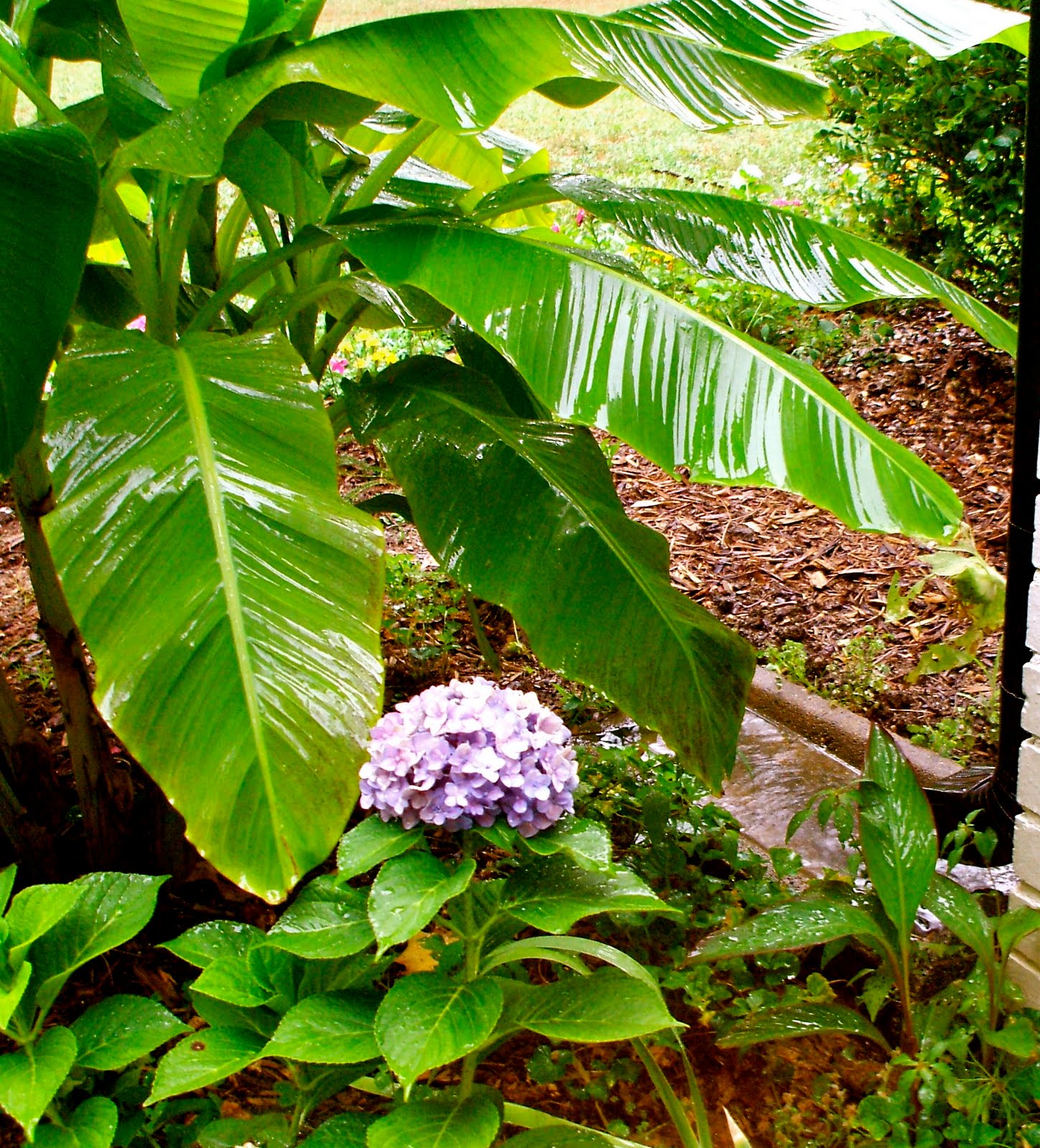
I am back this weekend from the southeast garden of God to my own garden. This week I have enjoyed the summer's new generation of birds coming to the feeder; they look so inexperienced and unsure of what they are supposed to do and what they are supposed to be afraid of. They make me laugh. I harvested the last of the sunflowers, drying now to feed them as they grow older and the days grow shorter and colder. And it has finally rained. Good, multi-day, soil-soaking rains. And when it's not raining, it is so humid it might as well be. The crab grass in my lawn is finally filling in the dried out spots and crowding out the plethora of other lawn weeds. The cosmos fell over from the unaccustomed moisture keeping their roots from being cemented into the ground and had to be tied up. In spite of the rain, though, it has come to my attention that the garden is not really thriving. The banana tree continues to produce new leaves, but it’s not gaining the height I expected it to. There are many hostas and ferns, but they have not grown large and lush, as I expected them to. The cosmos are barely blooming, though the stalks are healthy; the shade annuals are not much bigger than they were two months ago. Only the marigolds and vinca--and the grape tomatoes--are doing well. It is a drought year. We all experience those years. But I have concentrated so hard these past three years on quantity in my gardens, that perhaps I have overlooked quality. I water and weed and deadhead, but I wonder if I am missing something in the care and pampering of my plants. For one thing, I don't fertilize as I should; but what else should I be doing? Or do I just have too much expectation?

I asked someone last week how she was doing, and I received a litany of what she was doing. In the garden and in life we continue to think that if there is just enough on the menu, we can ignore the quality; if we keep busy and keep checking off the items on our to-do lists, we can avoid looking at how we are doing in our personal garden. We can skip the self-care fertilizer. Yes, there was a drought this summer and too much heat. And sometimes in our lives--as in the garden--survival is all we can manage. Just keep our heads above ground and get through. But at what point do we have to go deeper? At what point do we have to go deeper, in spite of our busyness or our drought? At what point do we need to pull out the plants that aren't blooming but whose healthy stalks are shadowing other plants that might bloom if they could get out of the shadow?


My children grew up on suburban streets. As I caught fireflies in a jar and pinned toads in the beam of a flashlight with my grandson, Max, and his mom and dad last weekend; as we looked at the stars and watched lightening flashing between the clouds in the dark skies over the mountains, I felt so glad for Max's childhood, and I wished that my children could have known that kind of play. But their father and I, in our love for the gardens of God, took them to places beyond their suburban homes. We planted a love of the dwelling place of the face and the soul of God into their bloom. I am growing my own garden in the city, for now; and they have returned to the gardens of God, beloved by their mother and grandmother: Emma to the Pacific Northwest, and Nicholas to the Blue Ridge. I guess I did okay after all.

Sunday, July 25, 2010

Which of These Things Just Doesn't Belong Here?

One of things I loved about having small children was watching Sesame Street. I especially loved the double meaning songs and jokes; one meaning being over small children's heads, although they were oblivious. The creators were brilliant at keeping us adult children engaged with our kids. A favorite of mine was Letter B, sung by a quartet of shaggy-haired muppets. It brings a smile to my face even now. Another song that still goes through my head frequently was the introduction to a matching game: One of These Things Just Doesn't Belong Here.

A one-time friend discouraged me from planting a banana tree at the corner of my house. She said it isn't native to North Carolina, that it doesn't belong here. As it happens I am not native to North Carolina either. I am not even native to the South. And yet, here I am. I have thought many times over the years that I don't belong here. I know I was out of place in Mississippi the four years I lived there. I don't know if I ever could have belonged there; in large part because I didn't want to. The escape from purgatory to North Carolina came none too soon.

But really, are we not all immigrants in this country? I grew up in Washington State, to parents who emmigrated from Michigan and Tennessee. REI, Starbucks, and Nordstroms followed me across the country from their original place of belonging. I like this state (though I would rather be in the mountain end) and I like banana trees. We leave one home and we make another place our home. If we believe we belong, if we want to belong, then we do.

I have strayed off the map so many times over the past years that I sometimes haven't known if I even belonged in my own life: I began in the Pacific Northwest and have ended up in the Southeast. I thought my life was meant to be encased within another’s, like Russian nesting dolls. I unquestioningly followed the plan to be married to and supported by a husband until death do us part, and I ended up divorced and the sole support of myself. I never questioned my heterosexuality, but discovered myself as a lesbian after nearly 20 years of marriage. When I was 40 I went to graduate school, expecting to be a counselor, and ended up a bookkeeper. Have I lost myself? Or have I found myself? Did I not belong then, or do I not belong now? I have stopped asking the questions. I believe I have always been myself; I believe I have always belonged. I have always belonged in the moment. We are at least partially responsible for what comes next, but we can't predict it. I can't predict forever success in the garden, but I am willing to give anything I like a chance. I will enjoy the plant until its time is up, whether it's a month or a decade. I have never lived a lie. I have never failed at anything, which doesn't mean it lasted forever. I am not sorry for any of my choices, or any direction my path wound. I have no regrets. All any of us have for sure is right now.

I am sure you have been asked, perhaps by a therapist or the author of a self-help book, "Where do you want to be five years from now?" It's a favorite question of those who think they know how to help us get motivated. I have tried to answer the question, perhaps it's why I went to graduate school. The truth as I know it now, though, is in five years I want to look back and know that I lived those years, that I took risks, that I wasn't afraid--or if I was, I did it scared. Five years from now will take care of itself. These moments are the ones that matter; I will never get them back. I am not, anymore, easily discouraged from trying what I want to try: being a counselor, living alone, camping by myself, playing the violin, subscribing to Match, planting a banana tree.

I gave birth to my own children, but I am a strong believer in the beauty of adoption. I read articles and receive advice about planting native plants and drought resistant plants in the garden. In one column the author/gardener said he plants his garden and never waters all summer. That sounds plain dull to me, though it would provide more time to sit in the air conditioning and watch TV, instead of sweating outside. My garden is my family now; I take care of its needs, it depends on me, and it gives me pleasure. There is a lot of adopting and adapting going on in the garden.

Last fall, just before the last chance planting date, I planted my banana tree. I followed the advice I read and after first frost I cut it down to the ground and mulched it. (The other option was to cut it a few feet above the ground, build a heavy gauge chicken wire coop around it and fill it with mulched leaves. That sounded a bit too much like taking care of children.) In the spring I eagerly watched for emergence. Nine stalks sprouted in an area the size of a dinner plate. I didn't know if I should thin the grove or not, so I let it make its own way. "One of these kids is doing her own thing." Now it is healthy, lush, and beautiful; but not tall, at least not yet. I asked a sister gardener I met while walking in my neighborhood about her banana tree. She told me to cut it off as high as I can reach and leave it. No need to mulch in this climate, especially if it's near the house. In the spring it will sprout out of the dead stalk and have a head start on height. I love things that sprout from dead stalks. Hydrangeas do that, too. So do I after the winter hybernation.

After the risk of frost last spring, I planted a variety of seeds in my garden. When they sprouted, I found that I couldn't tell the seedlings from the weedlings. I didn't know what to do. Should I pull the ones I think are weeds? If I guess, I risk pulling up the desirable plant. I chose to watch and wait until it became clear. Just as I waited to discern the difference between flowers and weeds in the garden, I wait to see which vines of my life now will hold my heart together and which ones will squeeze the life out. It is not always clear at first. Which vine is the passion flower and which is the cat briar?

Believably, 2010 is the hottest summer on record here; yet I am enjoying being outside more than I ever have. Not working, just sitting, away from pavement and cars, in the shade of the dogwood tree that catches the breeze. Watching and listening to the birds that flock to the feeder and flit and zip through the trees. I got a backyard birds book and I am learning their names. Yesterday the fluffy young cardinals discovered the feeder and entertained me for an hour. The titmouse and chickadees, so cute, have started stopping by. I keep an eye on my plants and discern which to plant more of next year and which ones don’t want to belong (they are my Mississippi plants). Sitting in the dark under the tiki lights I listen to the cicadas and watch the dance of fireflies. I have let go of the fact that it is ridiculously hot. I have stopped complaining about that which I can't control. I have decided to belong to this moment in this place.

And I planted a banana tree. It reminds me of a magnificent day of hiking through small banana farms in the hills near Mt. Kilamanjaro three years ago when my sister and I visited my Peace Corps volunteer daughter in Tanzania. Everytime I brush by my tree(s) and look deep into its broad leafed soul I am transported back to that day. Back to that day in a country in which I didn't belong. And yet, there I was.

Sunday, July 18, 2010

Thirst

It rained this weekend--lovely, thirst quenching, rain barrel filling, dancing, singing, blessed rain. I think it's been a month since significant rain fell on my garden. On Friday night I stood on my deck, turned my face to the sky and let it wash away the dusty draggy feeling of drought. The rain washed over me as it filled the pores of the garden. Renewal.

I get tired of the summer garden, watering and weeding. The plants look tired, too. I water, and it keeps the plants alive, but it can never be the same as Mother Nature's rain. This summer I am being intentional about loving the garden through the dry periods, the time span when there seems to be no growth (except for the crabgrass and ground ivy; though if not for those and other exotic "grasses" I would have no lawn). Does God as gardener get tired of me during my frequent droughts? Or does the Gardener wait it out with me, pay closer attention to me, patiently helping me see beauty in my life when it seems there is none? And so I am looking hard for the less transparent beauty in the garden. I am staying outside in the heat so I can see. Here is what caught my eye this week:
     1 The sparrows at the cafe where I write were back with their young. They perched on the edge of my table, they bounced around looking for food, the mama checked out a couple of things and rejected them (I think it was sugar granules from my scone--perhaps she knew it was not nutritiously worthy of feeding to her offspring). She fed the youngsters in turn, even though one wanted more than its share. A young one chirped indignantly when the family flew off without it before it wanted to go.
     2 There was a bright green dragon fly on the Carolina jasmine on my porch rail, and a baby praying mantis on the summer phlox.
     3 I harvested my first two sunflowers. I have been watching for the seeds to turn the characteristic black striped that we know of sunflowers seeds in the cellophane bag at the market. I cut the two down and hung them upside down in a paper bag in my shed until the seeds finish drying and fall out. They will provide food for the birds this winter.
     4 In times of drought, the plants put all their energy into preserving their core. Many of them don't flower, they don't grow, some wilt (as much from heat as from lack of water--like me). After the rain the blooms on the plants pop back within hours: the pentas, the Mexican heather that hasn't bloomed for many weeks, the impatiens. I swear the clumps of vinca and marigolds in my front garden doubled in size between Saturday morning (before the rain) and Sunday morning. All that was wilted is standing straight. Some have burned leaves from the heat and drought; they will take longer to fully recover, but they will. They will recover in spite of the parts that are lost.
     5 The Sum and Substance giant hosta and the Purple Heart have funnel shaped leaves; it's as if they were designed to catch the rain and direct it to the roots.

In times of drought the plants put their energy into preserving their core. Don't we do that in our lives, too? When we are grieving or facing serious illness or transitioning, we shed all that is not essential to survival and concentrate on preserving that which is central. Sometimes all we can do during a dry spell is wait it out. One of the essentials for me during the time of waiting is tears. A bit of wisdom I learned in counseling school is that, while therapists (and friends) should keep tissues handy, we shouldn't shove them at a person at the first tear sighting. We need our tears. We need to learn to be okay with them; to welcome them as a friend. Tears let out the frustration and disappointment. Tears keep us watered and at the same time keep us from drowning in held in grief. (How ironic that a few minutes after writing these words, Leslie Gore is singing, "I'll cry if I want to" on the cafe musak.) Words on paper also take sadness out of my soul and into the world where I can look at it. And friends are essential to me. Friends who know when to push and when to hold on to me; friends who know when to let me be and when to get me into the world. Friends are central to my self-preservation.

I have noticed over the years that sometimes what I receive from friends and my writing and my prayers is not what I want to hear. Often it makes me angry and resentful to receive what I need. I don’t know if that is what happens when the plants first get the desperately needed rain and they droop from the unaccustomed weight of it, but it is what I thought of when I saw them lying prostrate on the ground during yesterday's rain. But in the end, when we are ready to let it soak in, the truth brings us back upright to the fullness of life.

Yesterday thunder rolled through the sound waves for hours. The sky turned dark with expectation of more needed, hoped for rain. And then the clouds moved on. The thunder kept rumbling in the distance, the sky turned dark again and then light again. This has happened several times over the past month, with no rain. Expectation. Disappointment. A relentless cycle. And then the rains come. So often we feel on the verge of something wonderful in our lives. We prepare for it, put all the ducks in a row to make it happen. We are ready. And then something shifts and it doesn't come. Expectation. Disappointment. 

I am rereading, for the unknownth time, one of my favorite books: Everyday Sacred by Sue Bender. I always seem to know intuitively when I need to read it again, and my eyes notice it on the shelf. The author tells the story of three bowls. "The first bowl is inverted, upside down, so that nothing can go into it. Anything poured into the bowl spills off. The second bowl is right-side up, but stained and cracked and filled with debris. Anything put into this bowl gets polluted by the residue or leaks out through the cracks. The third bowl is clean. Without cracks or holes, this bowl represents a state of mind ready to receive and hold whatever is poured into it."

The bowls remind me of the Sum and Substance hosta and the Purple Heart with their funnel leaves; holding the water until it is ready to trickle down to the core of its being. Sometimes I am that first bowl, so busy being productive or otherwise ignoring whatever it is that I don't want to look at, that I don’t notice when the very thing I want presents itself. Sometimes I am the second bowl, with such a fierce judging voice that focuses on what is not working or what is missing or the disappointments, that I am unable to see or appreciate all the things in my life that I love. And sometimes, wonderful times, I am the third bowl, able to be present and absorbed in what I am doing, whatever it is.

Most of the plants in my garden don't die from thirst, just like we don’t die from disappointments. We look to our core strength to help us hang on until we can ask ourselves again, “What do I thirst for? What do I need in my bowl? What do I want in my bowl?” And even, "What wondrous things are already in my bowl?"

Sunday, July 11, 2010

Dividing the Garden

I joined the NAACP last week. And I let my membership in AARP lapse. I feel more need to show solidarity right now with people of color and those divided by socio economics than I do with retired persons. I am outraged by the actions of the majority on the Wake County school board. I will leave to others who know more than I about what a return to neighborhood schools would mean for diversity in our community and beyond, but the behavior and rhetoric of the school board majority and the hatred and inhumanity of their followers that write letters to the editor and online responses to news stories, simply put horrifies me.

Division has a place in the garden. Recently, on one of those "cool" days in the 80s we had a couple of weeks ago (it seems a distant memory), I edged my sidewalk, dividing my lawn (or the weeds that I call a lawn) from the pavement. I re-edged my garden to keep the lawn from encroaching. One of my beds has the less-than-attractive black edging around it, while a brick border separates other beds from invasion. All to keep lawn and flowers separate, but equal; all in their place. Bulbs need to be divided so that they can grow better. Trees and shrubs need to be pruned in order to thrive. Weeds have to be pulled because they will take over if given a chance. I have boxed flowers into containers rather than let them roam free. But this week I have been thinking about the way we divide people from people.

Five of the books I have read this summer, by pure coincidence, have similar themes: The Help, Katherine Stockett and Blood Done Sign My Name, Tim Tyson (the southeast in the 1960s); Stones into Schools, Greg Mortenson (the middle east in the present day); The Postmistress, Sarah Blake (Europe and the USA, WWII); and The Things that Keep Us Here, Carla Buckley (current day pandemic). Each of them are stories of divisiveness; of one side against another; of the consequences of holding one group of people down and using their backs for one's own climb to the top. Us and them. This is the strong root giving life to family squabbles, neighborhood rumbles, city riots, and international wars. I see that happening in the neighborhood school takeover: people in power using their status to do harm in the name of doing good--for their own kind.

We self-divide all the time. We choose what church we will attend and what neighborhood we will live in. We rule out friendship with certain populations of people, sometimes by choice and sometimes by lack of opportunity; sometimes by inability to communicate due to different languages, interests, or experiences. We make decisions, consciously or not, that separate us from those who choose differently. Although these are our choices, I daresay we are always the lesser for it. But why do we choose these containers? I believe it's often because we are afraid of what we don't know, it makes us uncomfortable. And we don't know it because we didn't learn it. And we didn't learn it when we were children. We hang on tight to what we learned in kindergarten, for better or worse.

I grew up in a small town that was divided only by railroad tracks: socio-economic division. There were no people of color in the entire population of the town, much less children of color in the classrooms. There were four elementary schools and we went to the one nearest our home, but we all joined together at the solitary junior and senior high schools. One of the neighborhood schools was in the center of town and the other three on the edges, beyond the tracks. The town school was exclusively the relatively upper class students, one of the others was the lowest income level, and the other two were mixed low and middle income. When we all arrived at secondary school, I longed to be in the Edison School clique, a clique that remained securely intact for the next six years. The Logan School kids remained, for the most part, the untouchables. PE teachers sometimes chose those kids to be team leaders because they were the toughest; and even they, in the unconscionable custom of letting the captains chose teams child by child, picked the Edison girls first. I am grateful beyond measure now, that I was not fenced into a clique, that I was not among the chosen few. I can see now that adult cliques are what happens when we don't learn early in life that the world is not made up of people just like us, and that none of us are better than anyone else. If we don't learn to play together in the sandbox or share stories in creative writing class, we will rarely be able to do so as adults. And those who are oppressed will have nothing to lose by fighting with violence and hatred for that of which they have been deprived. And in one way or another, most of us have some level of oppression, even if only because we have been kept in containers in elementary school.

One of the arguments for neighborhood schools being touted by the school board majority is that kids shouldn't have to ride the bus when there is a closer school. I am pretty sure they never asked the kids if that is a hardship! My first two years of school the bus passed my house twice. Every chance I got I caught it on the first passing so I could ride to the end of the route where my best friend, Maggie Jo Cummings lived. The next four years, in another town, I could walk or be driven half a mile and catch the bus on its last stop or I could get on at the end of my driveway, the first stop, and ride for an hour. (Of course, it was reversed on the return trip.) I usually chose the long trip (if I could get down my Cocoa Krispies--the only cold cereal I would eat--fast enough). I liked the view around the hill and through the dale, I loved watching the day break, I needed the transition time between home and school and back again; I did my homework; and I saw how others lived and spoke to those I would otherwise not have known.

I tried to enlarge a strip of garden in the midst of this drought. Now if I had actual grass, it might have come up easily; but weeds hang on with impressive tenacity, especially when they don't have enough water. I finally had to give up the fight. It is only through the water of education, a spirit of open-mindedness, an acceptance that we are all children of the one who is More, a willingness to sit side-by-side with people with different experiences than our own, even when it makes us uncomfortable, that we will let go of the dry soil and learn to live and work together in the world rather than dividing and destroying ourselves and each other.

Division and containment have their place in the flower and vegetable garden, but not in God's garden. Children who go to school with their own kind, are more likely to feel a sense of entitlement to preserve that lifestyle as adults. Sometimes we have to box teenagers and adults in because they are believed to be in danger of harming themselves or others. They were boxed out as children, and consequently later they have to be boxed in. No one, no one at all, is well-served by a world of people trying to preserve the garden for themselves.

Sunday, July 4, 2010

Hang on Little Tomato

I touched the first red grape tomato, intending to give it a gentle squeeze to see if it was ripe, but it let go of its tenuous hold on the vine and fell into my hand. Nothing to do but pop it in my mouth, bite down and burst the slightly tart juice over my taste buds. Perhaps not quite ripe, but it was my first homegrown little tomato.

When my sister gardener and writer (I'll call her Mel) gave me a tiny snap pea plant from her garden, I had had no thought of expanding my garden into the edible arena. But in the spirit of accepting a gift, I weeded and dug up a sunny, unplanted strip of earth along the chain link fence, enriched the soil with Black Kow and the first single bucket-full of rotting vegetables I could harvest from my small compost area, and stuck the plant in. (I laughed to see the not-quite-decomposed Brussels sprouts leaf and asparagus stem adornment.) It gave me a brand new spark; I went to the Farmers' Market and got a 4-pack of grape tomatoes and planted them, too. Then I sat back to watch for the results of my first foray into vegetable gardening.

Sadly, I only got two peas off the pea plant before something ate it. However, in addition to the grape tomatoes, a roma and three vine-ripened tomato plants and two squash plants are thriving. Where did they come from? I puzzled for weeks, before finally being clued in to the likelihood that they came from my bucketful of compost. A couple of weeks ago I counted more than 150 tiny green tomatoes. (There's not a lot to do in the garden right now.)

When Mel gave me that tiny plant, neither of us had any idea what it would start. A simple kindness that extended well beyond the edges of the gift. Next year I will widen the strip and plant the whole thing with vegetables. The point is, we never know when a word spoken to a friend or a smile directed to a stranger or an act of kindness shown to someone who may or may not have deserved it could touch a heart for a lifetime. (I should say here that everyone deserves kindness, it just may not be evident.) And how will those acts, given or received, change a day or even a life? “What happens to a story around the edges?...A story like a snapshot is caught, held for a moment, then delivered. But the people in them go on and on. And what happens next? What happens?” (The Postmistress, Sarah Blake). We most likely will never know that we have made a difference to someone. We won't know what happened next. All we have is the moment.

When I was eight, my family moved; but before we left Olympia behind, my big sister and I commuted with our dad for a few weeks so we could start in our new schools at the beginning of the year. That first day of third grade, Daddy and I walked into the school office. Daddy told the man at the counter (who happened to be the principal) my name and that I was a new student. A woman with her back to us turned around with a big smile and said, "Oh! She's mine!" She took my hand and walked me to the classroom. Those three words changed the course of that day, and all the days to come, for a frightened little girl. Thirty years later I ran across a birthday card she had sent me some years after I was her student. I set the card aside to remind me to write her a letter to make sure she still knew how much that day and that year in her classroom meant to me. Three weeks later, still not having gotten to that note, the mail held a letter from my mother containing Mrs. Rucker's obituary. I know I had told her that she changed the course for me (she served tea at my wedding, after all); I hope she still knew.

It should be remembered that bad deeds and angry words can also change the course of a life. My second grade teacher's name was Mrs. Louderback, and she was the troll under the bridge who ate billy goats and second graders for breakfast. And that's all I'm going to say about that. We all have words or actions we wish we could take back. Even if they aren't remembered by the receiver, they may be still hurting the one who delivered them. You know what I mean.

Today is Independence Day. I am not always proud of how my country, collectively or individually, treats others. Horrendous actions have been taken in the name of the stars and stripes. But, nevertheless, I am always glad that an accident of birth made this my home. And I am grateful to the courageous men and women who came before me. Some, like John Hancock with his bold and pompous signature on the Declaration of Independence, proclaim a self-knowledge that they are changing the course of human events, and they are well-known. But most are nameless people who unbenownst to them changed one life with a kind word or deed. Those actions increased exponentially to change a family, a neighborhood, a region, a state, a country, even a world.

Tiger lilies are a fascinating study in the unexpected. Their long, narrow, bright orange bud is unusual  in and of itself; but who could imagine what is hiding inside until it opens up to a most amazing flower. Five years ago my pastor sent me on a pastoral visit to a church member whose marriage had just ended. My second relationship had recently ended; I guess she thought I could provide understanding and comfort in a traumatic time. I listened, I let her cry, I was a caring body in the other chair. As my friend Jack says, much of ministry is just showing up. And we are all ministers. That difficult day changed the course of at least two lives. She tells me often how much it meant to her; and I her, as it was as much a gift to me. That single hour opened up to a beautiful and enduring friendship. I was asked to show up--and the affirmation in that simple request started the ball rolling. I said "yes." The door was opened to me and I was allowed into a life. And it changed the course.

We never know what a gift or a kindness is going to start--or how long it will be remembered--or how many lives it will touch. If we all lived life with the knowledge of the potential in each encounter, at the very least our own lives would be better for it. And perhaps that is all there needs be to justify our space on the planet.