Sunday, February 24, 2013

Focus on the Windshield


Given that my word for  2013 is “Possibility,” how could I not click on the AARP video ad I saw on FaceBook:


“Watch our new video and find your Real Possibilities for work, money and community.” The text of the video:

"A car has a rather small rearview mirror so we can occasionally look back at where we have been. It has an enormous windshield so we can look ahead to where we are going. Now is always the time to go forward and re-imagine all the possibilities that lie before us."

When I got in my car several days ago for a couple hours of exploration in western Lewis County, my eye dropped onto the sideview mirror’s warning: “Objects in the mirror are closer than they appear.” The juxtaposition of those two messages got their hooks into my imagination.

Our past can dog us even as the future is coming at us. There is nothing wrong with our past-well, there are always some regrets: things we wished we hadn’t done, things we wished we had done, and those we wish we were still doing-but the thing about it is, it’s over. We can’t live there. And if we keep looking back and letting our longings for what is gone take priority, we die. And we start calling that death life.

As AARP implies, it is good to look at where we have been a little bit, insomuch as our past can inform how we want our future to look. But mostly that big windshield is where our focus should be. And keep your eyes off the damn sideview mirror where that past wants nothing more than to catch up and snag you.

When I was driving across the country last summer, toward my new life, CuRVy’s windshield was my frame on the world. The life in the rearview mirror was getting farther away with each mile. All I had was this moment and this sky with these jaw-dropping clouds and this abandoned farm with the tilting windmill and this soy bean field with perfect undulating rows and this ditch full of water lilies and this circle of snow-capped mountains and this Venture.

And now what I have is Possibility.

Lent, as I have said annually on these pages, is my favorite season. It has been a time of turning inward, and giving myself permission to be self-focused. I have walked in the garden to see what is peeking out from dormancy. I have done collage to see what in my life has been stuck underground and wants to spring forth if I let it. I have built a fire and wrapped in a blanket for hours and not felt like I “should be doing something.” Because I was doing something: I was struggling to bring forth life out of death.

I am finding that inward walk harder to do in my new life. Without a job to provide a framework for my days, without the open space outside that frame that is clearly mine-mine to paint a dark sky color with an awakening streak of light splitting it open-I am having a hard time identifying what time is mine and what belongs to something else. But things change. This is a year of change, of adapting, of being open to new life. I am finding my way.

On Thursday, I went to the last session of my drawing class. I learned a lot in the class, and not only about drawing. For one, I was surprised to discover how much I like drawing faces. What was most surprising is that I have always thought the ability to do so was light years beyond my capacity. Apparently only because I never tried, and I never asked for what I wanted: to learn. I had my eyes firmly glued to the sideview mirror and the voice in my head whining, “You can’t,” arguably the two most debilitating words in the English language. The thing about drawing faces, I discovered, is that my rendering can look nothing like the model. But then I find one little thing: the too-wide mouth, the too-short forehead, the too-narrow face that isn’t quite right. I make that one small adjustment and suddenly the familiar face pops into recognition. Or at least comes closer. And I say, “Oh!” and then “Wow!” “No, I can’t” becomes “yes, I can.”

I observe again the significance of small adjustments over Capitol Lake before yoga on Wednesday. The gulls are fighting their way into some invisible wall of air, flapping hard and making little headway. Then, turning ever-so-slightly this way or that, they catch a current going their way and glide with ease.

As I watch the gulls, my mind drifts to myself trudging up the snowy hill on the Elk’s golf course, half a mile down the hill from my home, along with dozens of other children pulling sleds, heads bent and shoulders hunched pushing into the frigid wind. It is hard work. Then we turn, take a running start, fling our bodies onto our Flexible Flyers, and careen back down the hill shrieking with that exhilarating mix of terror and delight. And then we do it again.

The whispers I am hearing in this season of inwardness is to keeping looking through the windshield, to glance into the rearview mirror for what worked in the past (and what didn’t), to listen for what I want, to engage in the struggle, to make small adjustments as needed to direct myself toward my desired future, to stay open to Possibility.

Sunday, February 17, 2013

Spring Mourning

I left the Pacific Northwest as my life was teetering on the leading edge of summer. I was 24, and I was off for adventure. It was the end of May and spring was beginning to morph into summer in the PNW, too. The trees were greening, flowers were blooming, birds were nesting. With my new husband, I was heading out to tour the country in our homegrown camper-retrofitted VW bus: Orange Crate. It was 1976 and the country was celebrating its bicentennial. At the end of our Great Adventure we were moving to the other edge of the continent, where we would bounce between the mid-south and the deep south, though we didn’t know it yet. And I didn’t know it would be 37 years before I saw another Washington spring.

I am not a fan of southern seasons (especially summer), except for spring. Spring in the South is magnificent. It begins early, when children (and me) are still hoping for a renegade snowstorm. The daffodils bloom in January and every year people exclaim about how early they are. As the air warmed, weekends found me in the garden: looking for the hostas to poke up out of the nothingness of frozen earth; for the sedum and green shoots from the banana tree to emerge from the ground among last year’s frozen stalks; for buds on the brown hydrangea canes that I took for dead the first year; for the pansies I had planted in October to come out of hibernation and grow into the spaces. I watched to see if the Lenten rose would begin blooming at the beginning of Lent or hold off until Palm Sunday and stood eye-ball-to-eyeball with the cardinals in the greening Rose-of-Sharon tree out my second floor window.

The dogwood begins its step-dance toward glory. First the bud, then petals that take their sweet time opening like the roof of a planetarium to reveal the seeds like the stars, and then turn snow white and take on bragging rights. The shy redbuds edge in around the dogwood along the interstates, and the azaleas try their best to steal the show. I am not a fan of azaleas eleven months out of the year, but when the blazing scarlet and orange, the demure pink, the deep purple are flashing their stuff in yards across the awakening city, it is good to be alive.

All of this to say, in my three and a half decades away I never returned to the PNW in the spring. I came in the winter for Christmas. I came in the summer because I despise the southern heat and humidity- and summer is glory time in this corner of the land. I came in the fall because it is still summer in the fall in the South as I waited impatiently to turn off the air conditioning. But spring in North Carolina is not to be missed. And so, in the autumn of my life now, this will be my first one here since my 24-year-old self moved from spring into summer several lifetimes ago.

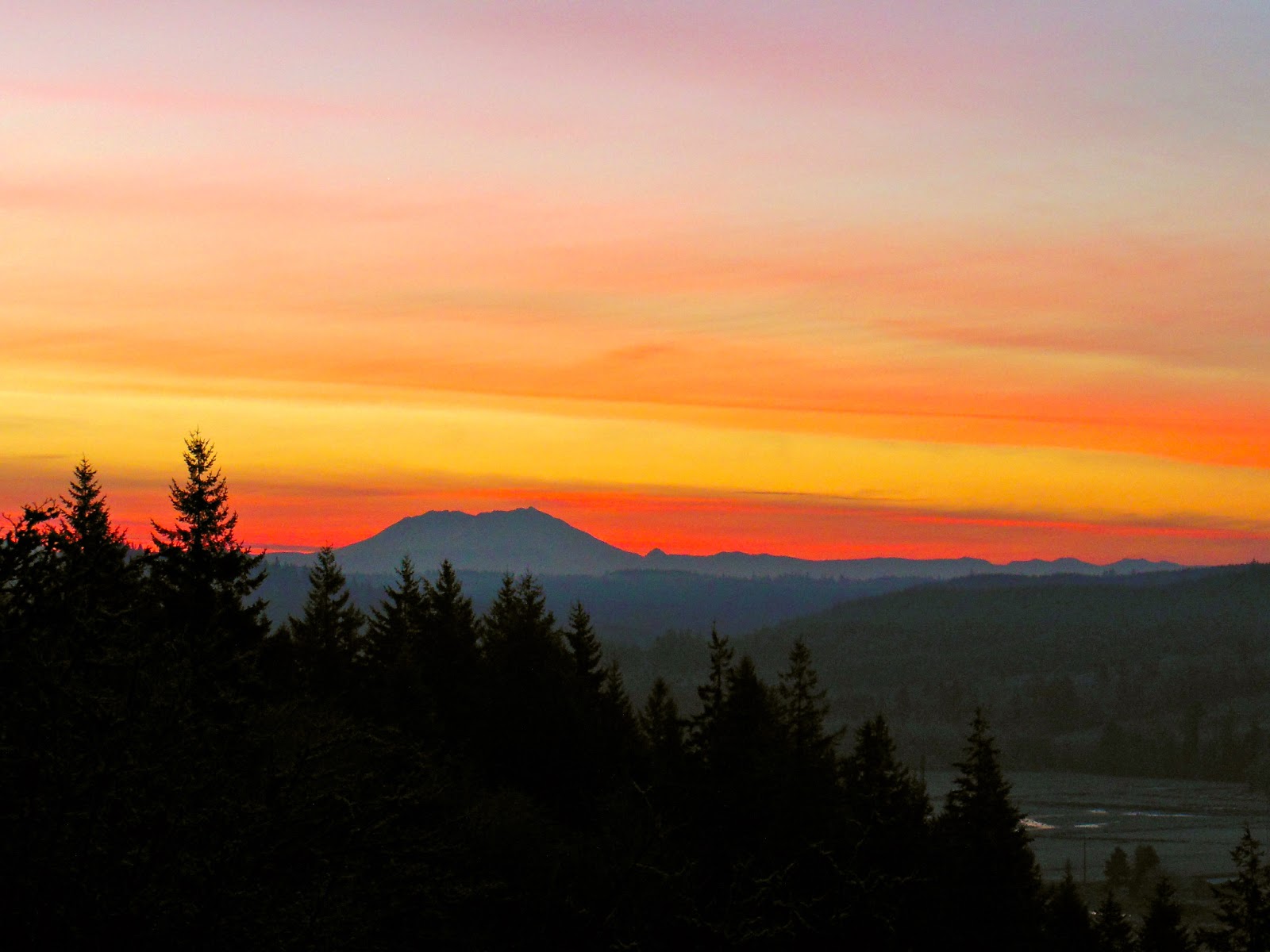
I go looking for signs of spring on Friday. It is a spectacular cloudless day; Mt. St. Helens shouting out against the blue. I find clusters of tiny snowdrops-a fairy angel choir rehearsing Easter. A solitary yellow wild strawberry blossom. Half-a-dozen reticent blooms on the espaliered forsythia. Tiny crocuses peek up cautiously just above ground level. The buds on the flowering quince are a little bigger and one of the daffodils has a swollen top. There are tiny buds climbing the stems of the chrysanthemums that should have been cut down after the first frost.

As I write it is raining again, the misty almost-can’t-see-it rain. The weather forecaster called it wet fog the other day. It’s what makes the summer here a gloriousity- when it finally comes sometime in July, when southerners are looking for escape. I look forward to rediscovering this forgotten season in my new old home, but I am mourning spring in the South. I anticipated this. I already have my ticket to North Carolina in April.


Sunday, February 10, 2013

Choosh

"And the idea of just wandering off to a cafe with a notebook and writing and seeing where that takes me for awhile is just bliss" (J.K. Rowling)

I have been doing just this for nearly a decade and a half now-sitting in a cafe with a steaming mug of coffee and writing in a journal whatever is in my gut and seeing where it takes me. I've been sharing a more thoughtful version with whoever wants to read it for almost four years. But always it is a reaching down deep into myself, usually with pretty much no knowing what I will end up with.

I have a new favorite word: Choosh. And you won’t find it on Google-at least I couldn’t. It is a biblical Hebrew word meaning “sense” or “feeling.” It is onomatopoetic-which is my lifetime favorite word-capturing the sound of a rush of breath that emanates from the deep reaches of the spirit. It is a word that speaks not of rational deliberation and assessment, but of inner vision. It is what you sense, not what you know.

I’ve been thinking about that word all week. When have I experienced choosh? When have I known deep down into spirit what I should do or what I thought would happen that defied all reason and fact? Certainly when I bought my house. It was ridiculous to think I could financially manage that, and crunching the numbers bore out my doubt. And I had no evidence that I could take care of a house all by myself. Then there was the garden: it was a mess. But my choosh was that it would work out, and I was the only one standing in the way of letting it happen. I bought that house, and that garden, and in the five years they were mine my life was changed.

When I first saw Ed Jones at the University of Washington in 1973 in the dorm we both lived in, I had barely been introduced to him before choosh, I knew I would marry the skinny man from the midwest with the wildly curly hair. Three years later it was irresponsible to conceive a baby with no income other than a graduate student stipend, but choosh we did it anyway: Nicholas. People kept cautioning me not to be so certain our second baby was a girl, and it would have been okay if it weren’t, but my choosh told me that she was: Emma. Deep down sensing.

I heard about a position that might be created at Pullen Baptist Church. I had no earthly business thinking I could be a financial secretary, but deep down spirit informed me that I was to go after it; and I did, even before it was open. And Ben, who recommended I be hired, listened to his choosh too, and took a chance on me. I grew that job and grew in it for 11 years before another choosh told me it was time to leave stable employment in the midst of a recession, to pack up and sell my house in a sluggish market and move across the country.

Those have been the big evidences of choosh in my life; I’m sure there are hundreds of small ones. Or are there? How often do I close my eyes, shut out the noisy world, and ask what is in my gut? Or just know without even thinking about it? There are the two or three times I have rolled down my window at the intersection and handed a dollar to the downtrodden person holding a cardboard sign asking for God to bless me. Once I handed someone the lunch I had just bought at Subway. Why? Choosh. A rush of breath that whispered “do it.” 

Sometimes I hear my choosh and let doubt persuade me to ignore it. And then feel disappointed in myself later. That happened recently, and I still feel bad. I pray that young expectant couple at the gas station who rushed to the hospital in the middle of the night without any money, got gas in their car to get home. Christina Baldwin writes beautifully in her blog this week of story happening at a rest stop on I-5 near Portland, her experience of listening to her choosh that surely changed lives: hers and the desperate mother’s.

Sometimes our decisions are driven by circumstances. We follow the yellow brick road, doing what we have to do, what gets thrown at us. We may go along for a while, trying to make the outcome different, all the while knowing in our deep spirit choosh place Oz won’t be where we end up or where we want to be when we get there. We close our eyes, shut out the racket, and ask what is in our gut, and finally follow it home. 

Do we take time to listen for our choosh? Will listening to what our inner guidance is telling us help us make decisions? I don’t know. But I am going to start paying attention. I shouldn’t have to be knocked over the head with it. Lent begins this Wednesday. I am going to engage a practice of slowing down, quieting my head, shutting out the world’s wisdom, and listening for my spirit wisdom. I am going to listen for my choosh.

“Let yourself be silently drawn by the strange pull of what you really love. It will not lead you astray” (Rumi).

[I am suspending my practice of using only the week’s new photos in my blog to share some photos of the inner spirit of flowers in my Raleigh garden.]


Sunday, February 3, 2013

Another Breathing Lesson

On New Year’s Day, two tiny daffodil sprouts bravely poked through the soil in the pot on the deck. A month later there are a dozen, but still only two inches tall. The early flowers grow slowly in this climate this time of year. As the air warms they will grow faster, and be blooming before you know it; but life in the winter is not in a hurry.

I learned a new word this week-I heard it twice on the same day: Imbolc. It’s a Gaelic word that means “in the belly” and can refer to the birthing time of lambs. Imbolc was yesterday, halfway between the winter solstice and the spring equinox. Life in the winter sits in wait in the belly-the belly of the earth, the belly of the creatures, my belly-until the time is right for birth and breath.

Yesterday was also Groundhog Day. That silly day when we look to a shy furry creature in Pennsylvania to tell us if there will be more of the same or if the time is right to erupt into spring. My friend Dori has embraced the day as her favorite holiday and made it personal. Is the time right to burst into whatever has been waiting quietly in the belly, or does it need more time to incubate in the dark? In honor of Phil not seeing his shadow, it is a spring-like day here. But though I look closely, I find very few signs that spring is ready to pick up the pace.

In the seven months of living with my mother, I have literally slowed my pace. She has taught me to match steps with her without impatience. Walking more slowly gives time to notice the temperature of the air, the smell of the evergreens, the clouds gliding across the pale sun, raindrops clinging to fir needles, the sound of the birds whispering in the bushes, the mountain glowing in the setting sun, the way the fog floats among the trees like visible breath.

It takes time to make the transition from unseeing speed to intentional awareness. I don’t get up and go to work these days-rushing from one thing on the list to the next, trying to get through the day’s tasks before quitting time when I can go home and try to breathe before a new day starts it all again, often continuing the list in my head even as I semi-sleep. I am more aware of my breath all the time now: the drawing in and the expansion of the breath in my belly...the movement of the air into my heart space...and the exhale into the world as I let go of that one, pause, then take another one in. I expect this is what happens to people when they retire: they have to relearn how to breath, and it doesn’t happen quickly. One of things rolling in my belly is how to return to work-which I must, eventually-and still remain in this conscious, unhurried way of living. Perhaps recognizing that desire is the first breath.

It’s been a busy week. One day a doctor’s appointment with my mom. Another day I need to accompany her on a couple of errands. Yet another day is my drawing class. Wow. Busy. My life has slowed down-I have a whole new definition of “busy.” But I don’t feel idle, just lucky to have the opportunity to concentrate on the breath.

Yogi Julie in Raleigh, in her 50s, after getting us into a pose that stretched my notion of what I could do, would tell us “two more breaths here.” I would think, “are you kidding me?” I breathed as slowly as I could, but her sense of time was slow. Trying to breathe fully, I still often took four breaths to her “two”; but by the time we came to her end, I was more comfortable with the discomfort. In my current class with the 20-something teacher, we are told “two more breaths,” and before I can finish one, she is on to the next thing. I contribute the difference to age, theirs not mine. Older people are more aware of time, and in less of a hurry to move from one breath to the next. I am glad to be here. I am glad to recognize the discomfort and take time to become comfortable with it. I am glad not to cram as much busyness as I can into each breath.

My friend Christina Baldwin, in her book The Seven Whispers, suggests three intentional breaths to begin each day: the first to let go, the second to be here, the third to ask now what? My living is somewhere between breath two and breath three. Moving from the letting go took time and it feels good to be here in the moment. I haven’t finished Christina’s book, but I am curious to see if she reveals what comes after the third breath. I suspect that moving into what’s next is not as easy as just asking the question and listening for the answer. But when we learn to breath slowly enough, we get comfortable with the discomfort. Maybe after the question is asked and the answer is revealed in its time, the next step will be as natural as one more deep stomach expanding breath. Meanwhile, being comfortable with uncertainty is today’s gift. There is time to think about what wants to be birthed and what needs to be buried, and what is still waiting for spring.


Note: I did birth a new blog this week about life with my mother. It’s called “Daughter on Duty: Walking with My Mother in the December of Her Life." I would love for you to join me there. http://daughteronduty.wordpress.com


Sunday, January 27, 2013

Drenched with Possibility

On the first Sunday of the new year I shared my word for 2013: Possibility. This week I began my formal exploration of my word. There are many more definitions of Possibility online than there are in the family Random House, the dusty oversized dictionary that has resided for decades in my family home on a special slanted shelf my dad made for it. There is the common one: “the fact or condition of being possible." But my favorite is: “Potentiality for interesting results.” That one beckons me into a wide open future. It peeks, mostly hidden, from around the corner with hooked index finger. It teases me toward exploration. It sets me dreaming.

Next I pull out synonyms that roll on my tongue and bounce around in my heart: plausibility, potentiality, feasible, achievable, realizable, attainable.

And then my favorite beginning exercise: finding quotes about my word. I love the internet. I find several to record in my notebook, to pull out when I need inspiration, or a kick in the butt. Again, I have a favorite, by a woman who proclaims herself an "idea-whisperer," which is pretty cool itself: “I have a habit of letting my imagination run away from me. It always comes back though...drenched with possibilities” (Valaida Fullwood). Drenched with possibilities. Wow. That is how I want to live. Drenched, like the valley on Wednesday when the rising sun turned its winter drab to gold. Drenched, like the first rain in twelve days left the trees and moss smelling green again.

Six years ago, at about this time, just before Lent (the season that I still my busyness and make space for whatever it is I have been ignoring), I thought about Possibility. What if I bought a house? I made a list of what that would mean for my life. I didn’t so much consciously decide to do it as I did follow the beckoning finger to the garden that changed my life. Neither a garden nor a changed life were on my list. A year ago, having turned that possibility to reality, I set my sights on returning to my soul home. It was a Bold Venture. It isn’t time yet for my next venture, and I don’t know when it will be; but it’s always time to be drenched with possibility.

I just read a friend’s blog post about her annual
week-long gathering of a group of women. At their first day check-in they each shared what their busy and productive year had held. Until the talking stick reached the group’s 86-year-old elder. Contritely she confessed that she didn’t know what good she was doing in the world. Everyday she goes to the coffee shop and tries to be friendly, “to make sure everyone gets a welcome as they come in the door.” One day she rocked a fussy baby so his mother could enjoy a cup of coffee. “You know,” she went on, “people just need to be seen. Just need someone to look up and say, ‘hi; glad you walked into the room.’ Mother Teresa said the greatest disease in the world is loneliness, that if she could heal anything about being human, it would be to cure loneliness with love. I try to be like that, to bring a little love into the space around me. But I feel old. I don’t have the hearing, the energy, or the big ideas I used to. That’s all I got to say.”

Selah. I invite you to breathe deeply and read that again, slowly.

Wow. Wow. I can imagine it was hard to speak in the room after that. After a selah, my friend, with permission to comment, offered this: “You are doing exactly what the elder in the village is supposed to do! You are tending what’s right in front of you. This is the fulfillment of your days—the capacity to slow down, to see what needs to happen next, right here, right now—with the young mother, with the baby, with the barrista, with the regulars from town, with us in the circle. Through these gestures of kindly attention offered into your daily surroundings you are a messenger of your deepest values. Every one of us who is moving faster, who is busy beyond managing, who is hooked into the necessities of technology, is counting on you being here amongst us moving at the pace of guidance and paying attention in the ways that you do.”

My mother is this elder to me. Because I am her family, with all the history that comes with a parent-child relationship, I don’t always see it. But everyone she meets is enchanted by her. People tell me all the time, “I love your mother.” She embodies kindness and hope and grace. She is proof that you don’t have to do anything earth shattering to change the world. Her nearly sightless eyes smile behind her dark glasses as she straightens her ever-so-slightly bent body and speaks a kind word to a restaurant patron. That person smiles at the child at the next table, because kind attention begs to be passed on. The child stops fussing and shyly smiles back, before giving her mommy a hug. And on and on into limitless possibility.

My mother and my friend’s elderly friend are preparing our elder places. Through them I see the possibilities for my own old age. But first things first. Right now I have today. Today I can dream about the possibilities in my still-energetic years. What I choose today will pave the way for tomorrow. And tomorrow’s possibilities will set the course for the next day. And all the while I will remember to smile at strangers. It could transform their day. It could call them to possibility.

My sister recently sent me this poem by Rabbi Yael Levy:

What is it that calls us forward,
To lift our eyes
And see that everything is possible?
Just for a moment to feel a strength beyond ourselves,
A love beyond ourselves,
And imagine we can step into the river
And change its course?

Perhaps it is remembering
That everything we do
Shapes the future
For the children we will never know.

Everything we create
Fashions a world for the people who will
Some day call us ancestor.

Netzach (victory) teaches
Raise up right action
And aim toward love and generosity.
Eternity exists in each moment
There is no separation between us
And what will be.

Drench yourself with possibility today. Selah.


Sunday, January 20, 2013

Let Your Breath Fill the Space

Out of frost-white meadows
of Scotch broom
tall firs rise ghost-like
over the interstate
gray aside naked poplars
their tops disappearing
like breath into
foggy mystery
white on white on white.

Gulls fly out
from the mystery
beyond the yoga window
for once hushed
and silently glide
over mist that floats
like breath
above the still lake
breath on breath on breath.


Fog. I love it. It creates space within me by shutting out all the distractions that are “out there.” It is foggy often here in my new old home. Many days I awaken just to the space extending to the first line of trees. No valley floor, no hills, no mountain, no town lights, no sky. Just me, my breath, and the ghostly trees.


The times in my living when I have felt my most authentic self, are the times I am in the spaces. Sitting high in the big leaf maple tree of my childhood, walking alone in the woods and to and from the school bus stop; sitting at a campsite by a river in the Appalachians, hiking around Mt. Rainier with only the birds and animals for company, driving across the expanses of this land. It is then that I am most awake, most aware, most connected. Yoga teachers remind us often to stay connected to our breath. The breathing that makes space in our chest and between our vital organs. Perhaps it is that reminder that makes me aware of the space as I drove to the coast last Sunday. 

The sky dawns blue, but a mist lingers above the frosty ground and cold lake and escapes from my mouth, reminding me again of the life-giving breath. Hoarfrost clings to all that is cold, tiny ice crystals expanding the chain link fences, vegetation, even spider webs into the space surrounding them. I am as aware of that space as I am of the objects. I look at the webs and see the spaces between the thickened strands. The ducks float in and out of the mist, taking up tiny silent space in the expanse of water. I drive out of town past the poplar plantation. The frosted trees glistening against the azure sky are beautiful, but it is the perfect empty spaces extending in straight rows in all directions that keeps me riveted as cover the mile of road between them and me, until I am beneath them and see only the unoccupied space. The swans standing in the marsh, perhaps sensing my presence watching them from the side of the road, slip soundless into the water, gliding into space among reflections. Even the frozen trickles of water dripping from the rocks are motionless, waiting, patient in the drop zone between their origin and their destination, taking time to breath before the warmth of another day sends them on their continuing tumble.


Perhaps it is the connection to space that often keeps me tuned into themes. Like this week, beginning with my road trip and continuing through the many foggy days. On Wednesday, as I drive to yoga through thick fog, the trees keep a sentinel watch over the mystery hiding in the unseen space.

In yoga, amazingly, the theme for the week is “letting your breath fill the space.” Inhale into your abdomen, bring your inhale up to your chest, expanding as you go to make space...drop your thoughts to your heart...use the strength behind your heart....


On Thursday evening, at the drawing class I made space in my life for, the lesson is on negative space. We practice drawing the space around the subject, rather than the subject itself. When the spaces are all drawn, the rocking chair and the big-horned sheep and Frida Kahlo magically appear out of the emptiness of the paper.


My sister sends me a blog post this week: “Breathe deeply. Our breath is our most immediate and vital connection to the life force that sustains us moment by moment. Let yourself be filled with awe and wonder at the marvels of this intimate gift.” Breathing, filling the space with nothing but our breath. As I write this post, my phone signals an incoming message from my other sister. She is struggling with her ongoing love/hate relationship with technology. She can’t send email from her new computer and she would like to not care. She is wistful for the lost days of simplicity (except it wasn’t really, of course) when everything was done with pen and paper and the phone was not so damned smart and stayed connected to the wall and didn’t even have an answering machine to tell you what you missed. There was more space, more time to breathe when we weren’t connected every moment of the day and night.

I catch up on my daily email from Writers’ Almanac and find this poem from one of my favorites, May Sarton, excerpted from “New Year Resolve”:

The time has come

To stop allowing the clutter

To clutter my mind

Like dirty snow,

Shove it off and find

Clear time, clear water
.
...
 
For it is now or not

As old age silts the stream,

To shove away the clutter,

To untie every knot,

To take the time to dream,

To come back to still water.


The time is now to embrace the space, to concentrate only on the breath, to find the strength in the space behind your heart. The time is now to discover what makes your heart leap up.  The time is now to create space for possibility; to make space for mystery.

There is a Portuguese saying that I used many years ago as a salutation on letters (both the pen and paper type and the electronic): Tomando canta. It non-literally means to take care; to drink care, perhaps to breath care; to fill oneself up with special and gentle attention. Drop your thoughts and your breath to the space around your heart. Spend time there.

Tomando canta, my friends.

Sunday, January 13, 2013

Power in the Stretch

If you are a follower of this blog, you know that one of the plants missing in my garden since I moved to the PNW in July is a just-right yoga class. I found the studio I love, and a teacher I like, in Olympia; but the class has not challenged me. Well. They started a new class this week, Yoga 1 and 2. I got my challenge; days and several Advil later my pectoral muscles are almost recovered.

I never would have chosen to place my mat behind the cute young thing that came in late and put her mat in front of mine, her yoga clothes showing off all her well- developed, clearly cared for parts very nicely. I groaned. Great. I know it’s not a contest and I am supposed to keep my eyes on what’s happening on my own mat, but I couldn’t help watching her. I couldn’t help it because when my 60 can out-yoga someone’s 20-something, I am going to pay attention. Maybe it was the first time she had done yoga, but I accept all affirmation. We did five full sun salutation vinyasas. I haven’t done even one since last spring. Mine weren’t pretty, but I kicked her cute butt.

In the middle of a warrior pose with a serious hamstring stretch, the teacher reminds us to gently stop the chatter in our head-the chatter that takes our mind off the discomfort of the stretch. “Keep your mind with the stretch, that’s where the power is.” The stretch is where the power is. That phrase has been singing through my mind, along with the sore pecs, all week.

After living alone for eight years, living with Mama is stretching me. It’s stretching her, too. Living in community, and doing it well, is not easy. Living with a blood relation is hard. Living with someone who is in a very different life-stage is challenging. Knowing that I am on a fast track to that same life stage is terrifying. What it is, is opportunity. Opportunity to stretch, to learn, to be curious. For that to happen, I have to keep my mind on the stretch, that’s where the power is. That’s where the opportunity is.

Mama says something that comes from a place of who she is, and it pushes a button in me. Perhaps a button from childhood, perhaps one that takes me back to an adult experience. I react out of that long ago, probably unexplored place of pain. Most of the time I shove my riposte away without voicing it, but I feel it well up before I let the mind chatter cover it. As is my way of being, I let it fly away and never look at it again. Ignoring feelings is learned behavior; learned in this very home I am again living in. I wonder how I would better serve myself to be curious; to stay with the stretch. Like: “Wow, where do I feel that anger that rose up in me, or that fear? Oh, it’s in my chest. I’m going to feel that, stay with it, investigate it.” Or come back to it. Stay with the stretch, it’s where the power is.

The last time I returned home from Seattle, the snow-covered Olympic mountains were glistening on the horizon against blue sky. I sped down I-5, skirting the city, and could glimpse them beckoning to me behind the Space Needle. It was morning, I wasn’t really in a hurry, and I thought about getting off at the Seneca Street exit and driving through the city center in workday traffic to the market on the shore of Puget Sound where I could get a full view. Robert Frost flitted through my mind: "stopping by the woods on a snowy evening," slowing down, taking time to enjoy beauty. But I was on the interstate fast track; it felt like too much energy to really think about getting off. I kept going. As soon as it was too late, I regretted my non-decision to stick with inertia. I didn’t keep my mind on the stretch to get off the highway, I let the opportunity pass me by. I read this somewhere a few days later: “Anytime we lop off the fantasy and romance from our daily lives we are hacking away at the quality of our existence.” I just lopped off that longing, and kept on going.

Spontaneity is not in my repertoire. Friday, after the fog dissipated and the day became crystal clear, after Mama’s physical therapy appointment, after lunch, as my head chatter tried to tell me it was too much of a stretch to spontaneously take off exploring in CuRVy-maybe I should curl up with a book-I remembered the missed opportunity in Seattle. I grabbed my camera and took off over the hill. I had no plan; I even forgot the Lewis County map. I didn’t know where I was going or what I would find. I wasn’t disappointed.

There is no power in the status quo. I’m developing my muscles and learning to keep my mind on the places that stretch me: physically and spiritually. The new day is dawning…I have a full tank of gas.